[Talk] First Light Telescope Conference 2026 - Towards specialized instruments
On October 17, 2026, I had the pleasure to give the opening talk of the 20th First Light Telescope Conference, sadly not in Portland, but remotely from France. It goes through the telescopes I’ve built since 2019 and the fracture with which ones I actually ended up using.
It was an honor to present among those seasoned opticians and makers.
The slides are available as a PDF.
Related posts :
- First light with the 8in f/3.52 hyperbolic telescope
- K2 was featured in Sky and Telescope
- Wallace the 6 inch f/2.8 telescope, building it, and hiking with it
- The tiniest yet real telescope I’ve built
Slides and transcript
Introduction
[R. Brown] I want to introduce Lucas Sifoni. I owe Lucas a debt of gratitude for having come up with the hyperbolic primary mirror for use with the Bader multi-purpose coma corrector, the MPCC and writing an article about that in Sky and Telescope because immediately after last year’s festival in which I showed festival last year’s conference in which I showed my own 5 in F3 3.5 astrograph that was parabolized and I was having trouble with field flatness and coma correction. I read in Sky and Telescope his article and I was like, “Oh my gosh.” So I hyperbolized my own mirror and it works beautifully. I wanted you to know that.
Lucas is going to do a presentation on I believe small telescopes and why they are of great interest to him and I think to everybody else. So, thank you Lucas from for joining us all the way from France. You can take it away.
[Lucas] Thanks, Robert. First I want to thank you for having actually built an hyperbolic Newtonian like I wasn’t sure if this telescope will be would be valuable for others and it’s it’s very nice to have feedback on that and that this Ed Jones trick is spreading around. It’s a great formula and many can benefit from it I think. So I’m going to share my screen.
For the record, I started in amateur astronomy in 2019, just before COVID actually. So, I’m quite a beginner in the sense of astron amateur astronomical age. And this presentation will be a bit of my journey of trying beginner telescopes, trying to build my own and all the feedback that comes with experience and what worked for me and what didn’t. You will see that most of what I built actually didn’t work didn’t worked for me at least. And how I’m a bit narrowing the design space of the telescopes I use and want to use. So they actually fit my wheels and desires in observing.
So let’s go towards specialized instruments for me and away from unfitting instruments.
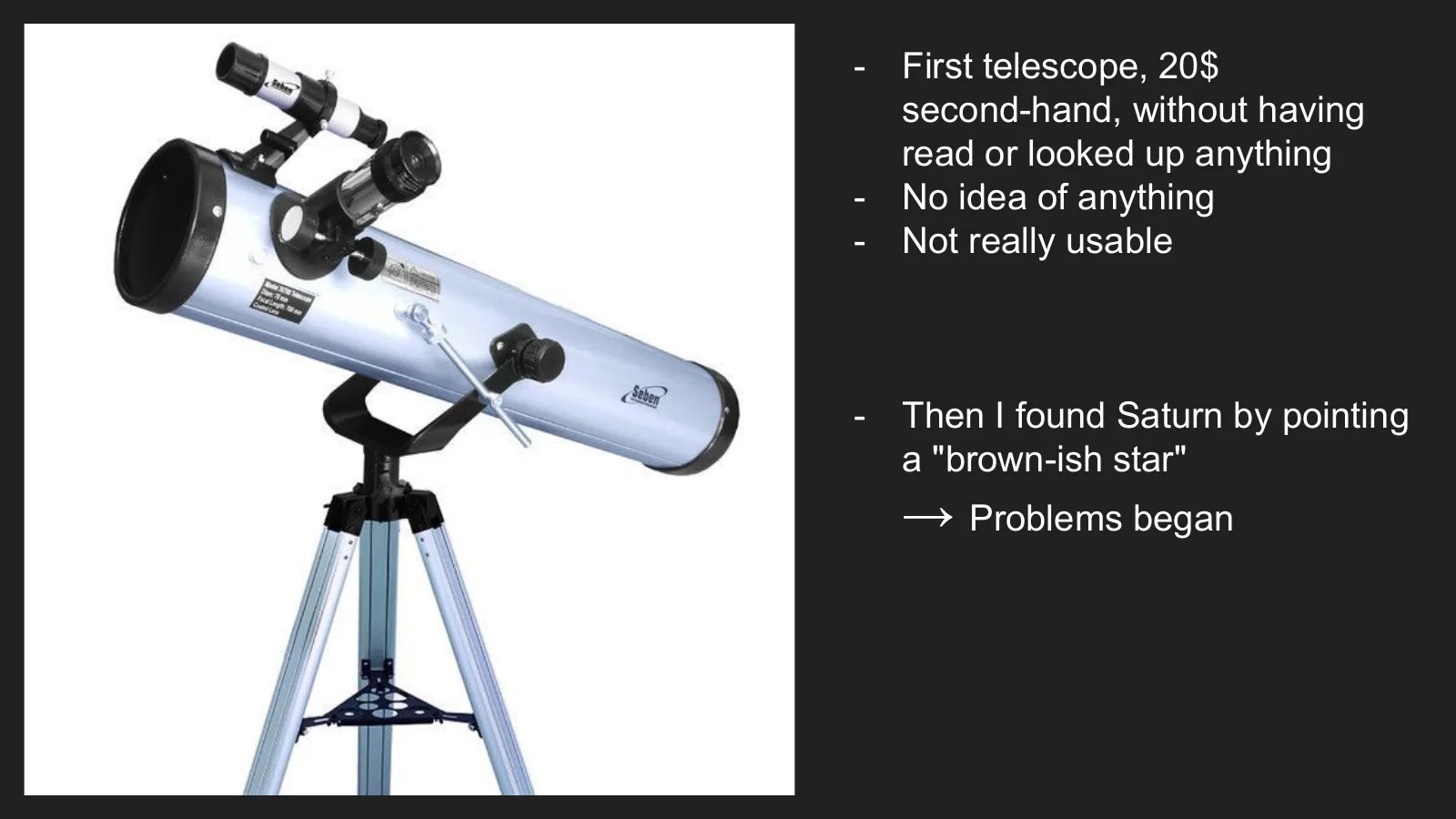
So I started with the Newtonian on the fork mount of doom which was very shaky. I had no idea what could a telescope show or anything about amateur astronomy actually. But I managed to find this model which in retrospect wasn’t the absolute worst thing I could have started with even if it was quite bad. And I have had the luck, or bad luck to find Saturn with it while stumbling around in the sky in my Bortle 9 city sky and I was immediately hooked.
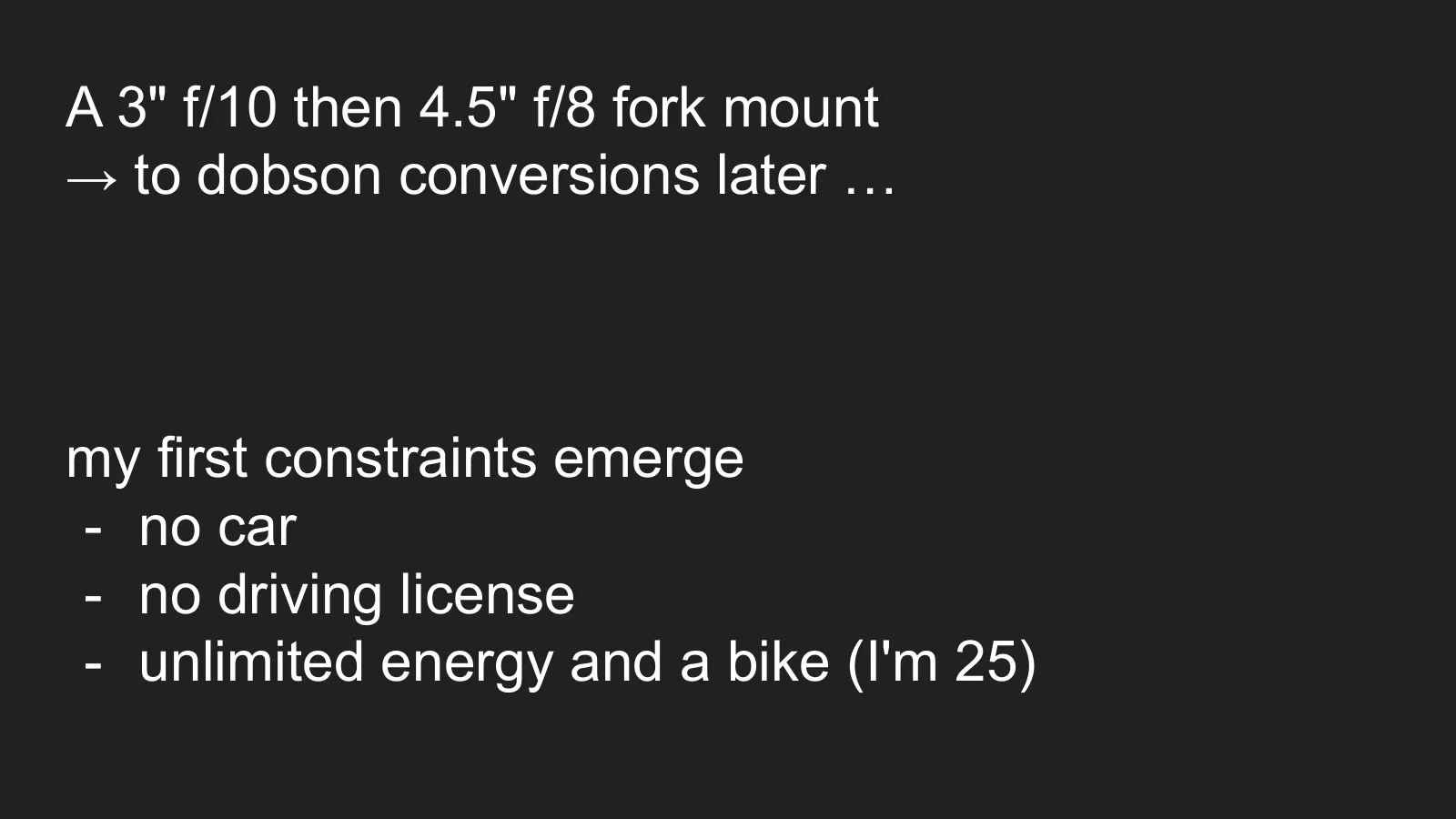
Problems began as I wanted to see more and so I found 4.5 f8 inch telescope again on a fork mount. I googled a bit and found that people modified them to make Dobsonian telescopes which I was just interested in the ergonomic side. So I didn’t read up on anything else. I just built Dobson mounts. But at the time I was in the middle of a city. I had no car, no driving license. And I wanted to access more views, better views. And I only had a plan of biking in the night with a telescope.
So my quest begins. So not knowing anything I Google how to shrink the length of a telescope.
I will find threads on forums, I think I discover Cloudy Nights at this point and people seem to handmake optics. It sounds quite daunting and a bit like a type two fun task which you work for hundred of hours and then maybe you have something joyful at the end. I figured I had no time for that.
But another Google search later I’ve had the trouble of stumbling on someone’s website.
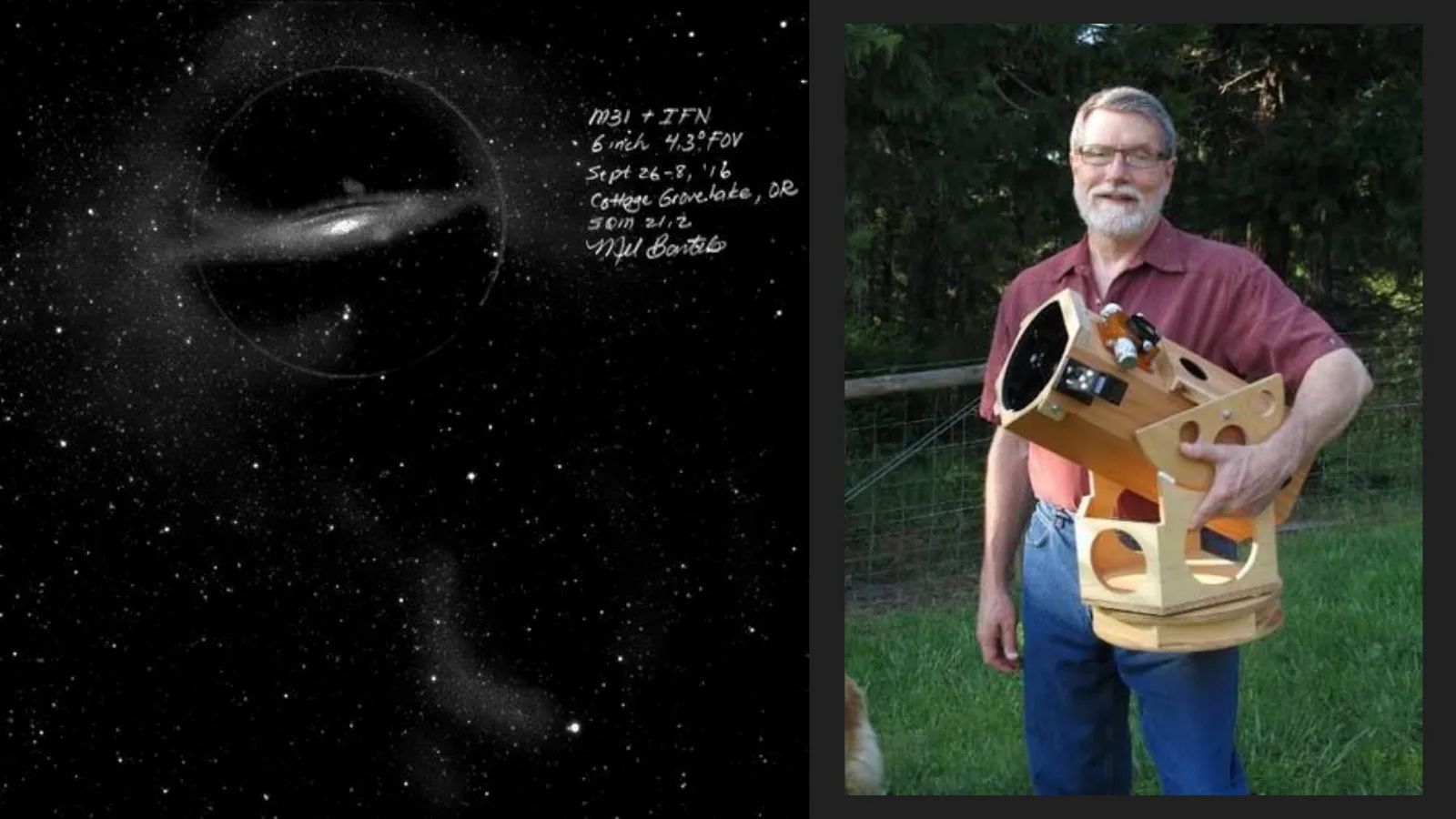
This someone was Mel Bartels and finding this particular drawing on his page about integrated looks nebulae and herchel’s ghosts I think that was the title and this drawing hooked me actually and it became my goal, I wanted to see exactly that so I figured that an 8” f/3.5 would be a great starting point.
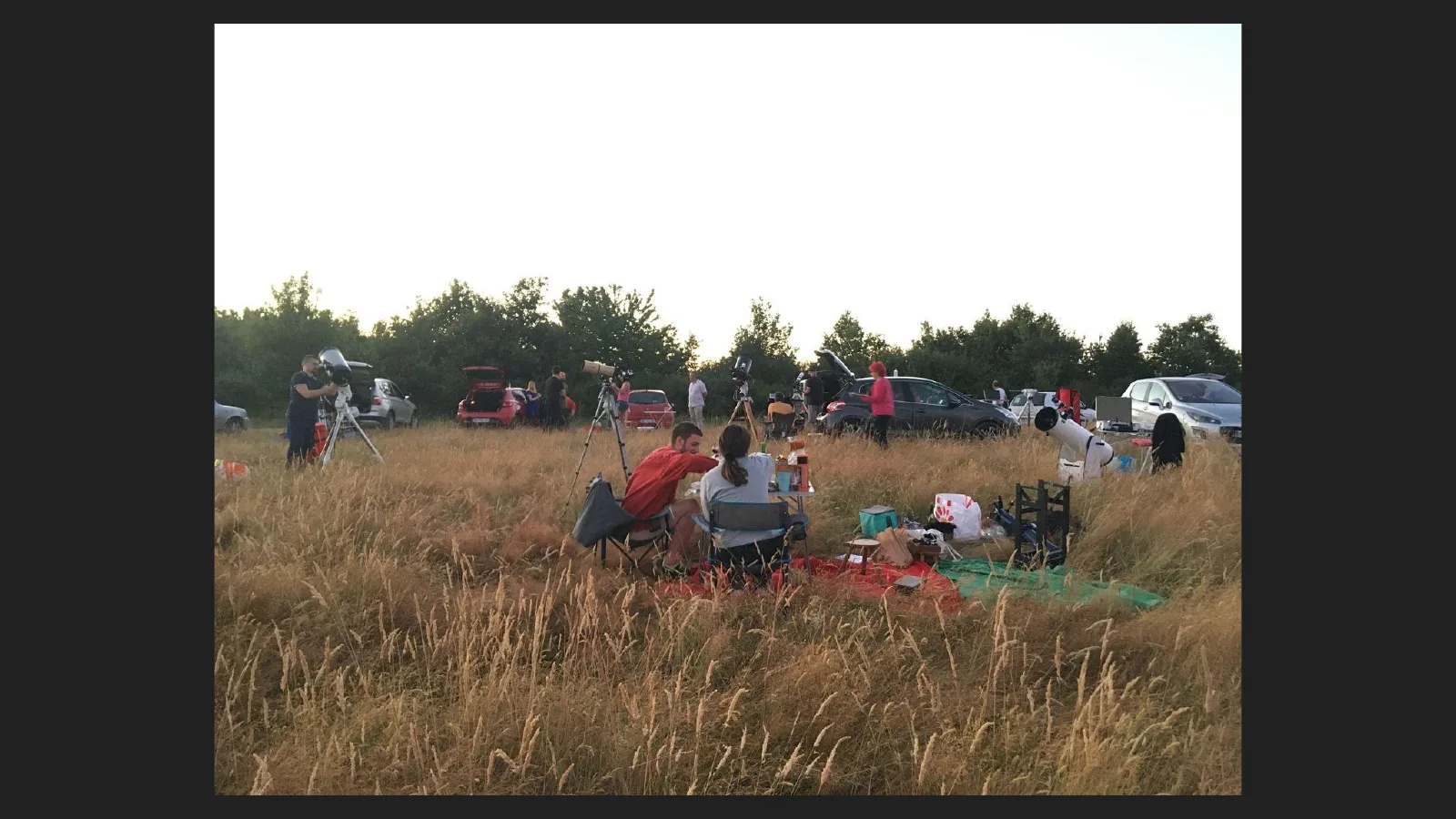
At the same time, I confirm this delight for this deep sky views by going to nearby star properties and I will start to make my first mirror on 8 in f 3.5. So, 7 50 mm I think in focal length.
So there’s already a bit of confusion and yeah I was a bit overwhelmed by all this information. I’ve read all the books. I was compulsive compulsively on Cloudy Nights and reading what people were doing and I still had no way to move from my city skies. But I wanted to have a go at it.
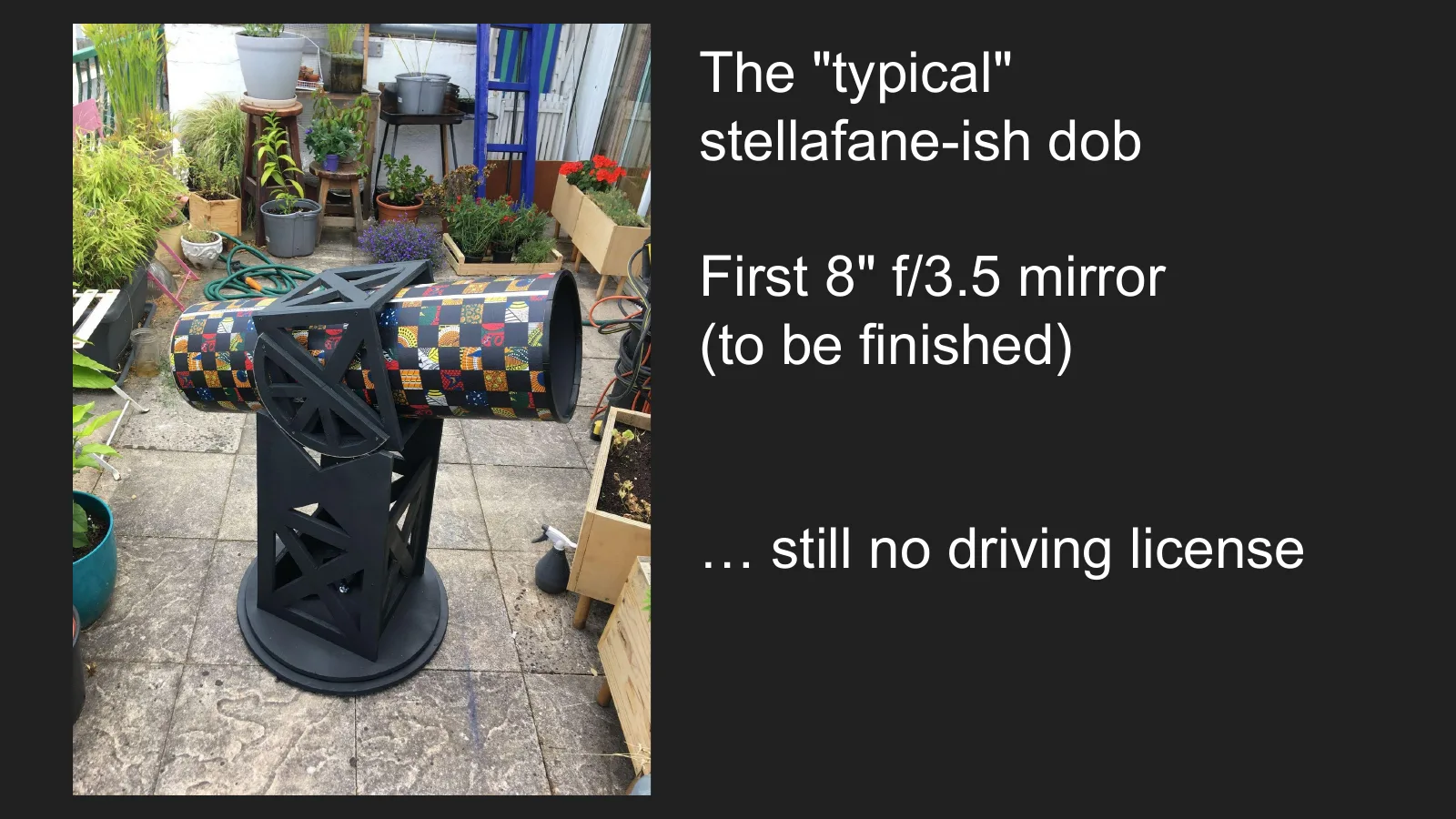
So I built the classical Stellafane dob, which was a choice of putting all the new knowledge tokens I was able to spend into making the mirror itself, and building something quite simple for the telescope parts so I could have some chances of success. I built it to honor the standards, position myself in the tradition a bit, and be on a beaten path. And in the end I realized that I couldn’t even use it, since I had no way of moving it around. I was obsessed by the build and didn’t really think about its practicality.
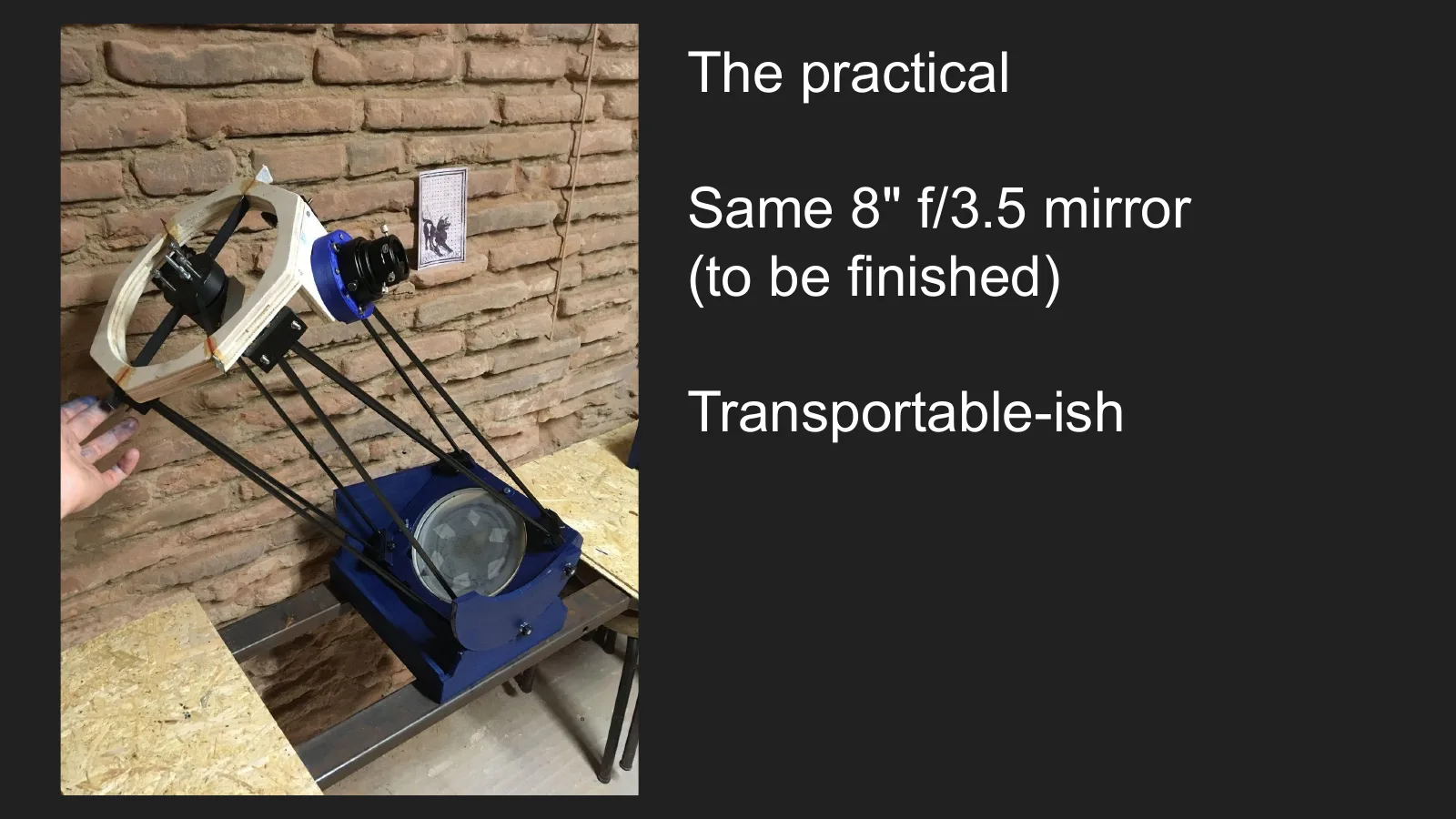
So I stumbled a bit on French forums and I discovered the Strock telescope, but I didn’t really have the tooling to build a full featured Strock. I was already a bit proficient with CAD and 3D printing, so I built something that is a bit like a Strock and a bit like Danny’s design (a Cloudy Nights member who uses a flotation cell on three points on ultralight 8” telescopes), and I went for a very lightweight single platform upper cage with a helical focuser. We can see that at the time I already had the corrector in the focuser, that an astronomy shop seller told me would be very fine for visual observing. I didn’t know better.
So this telescope was more compatible with what I needed: something that can be moved, and that would allow me to get to dark skies with my bike. But a first mirror takes a long time. I think I spent 18 months on it.
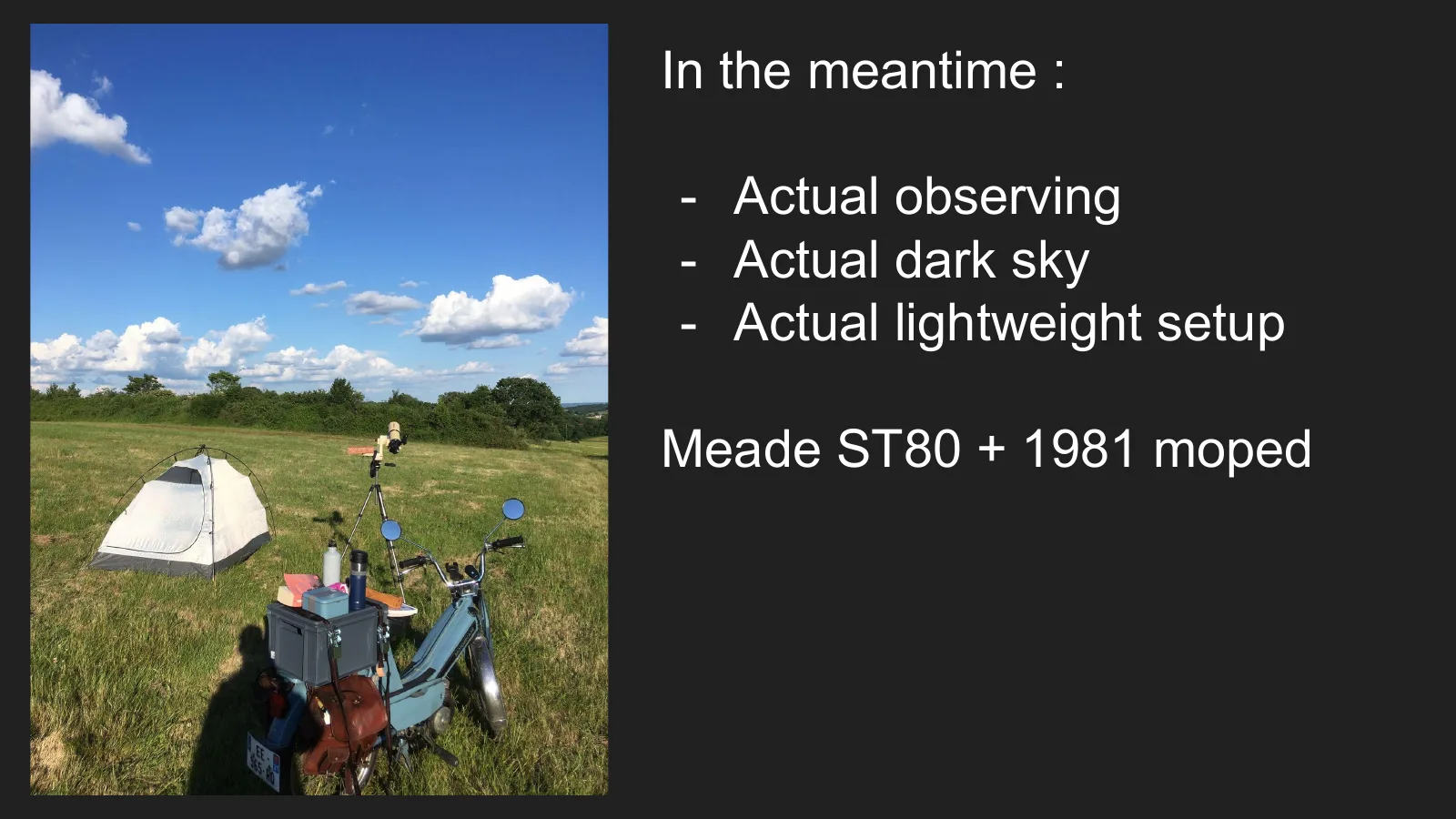
So in the meantime I did some actual observing, moving around with a moped from the 80s and a small Meade 80 mm f/5 refractor, and this confirmed a bit my interest for deep sky. I observed planets when I went out with other people, but they moved me less than a nebula, a globular cluster, or even open clusters in the winter actually. So this setup was quite close to ideal at this point.
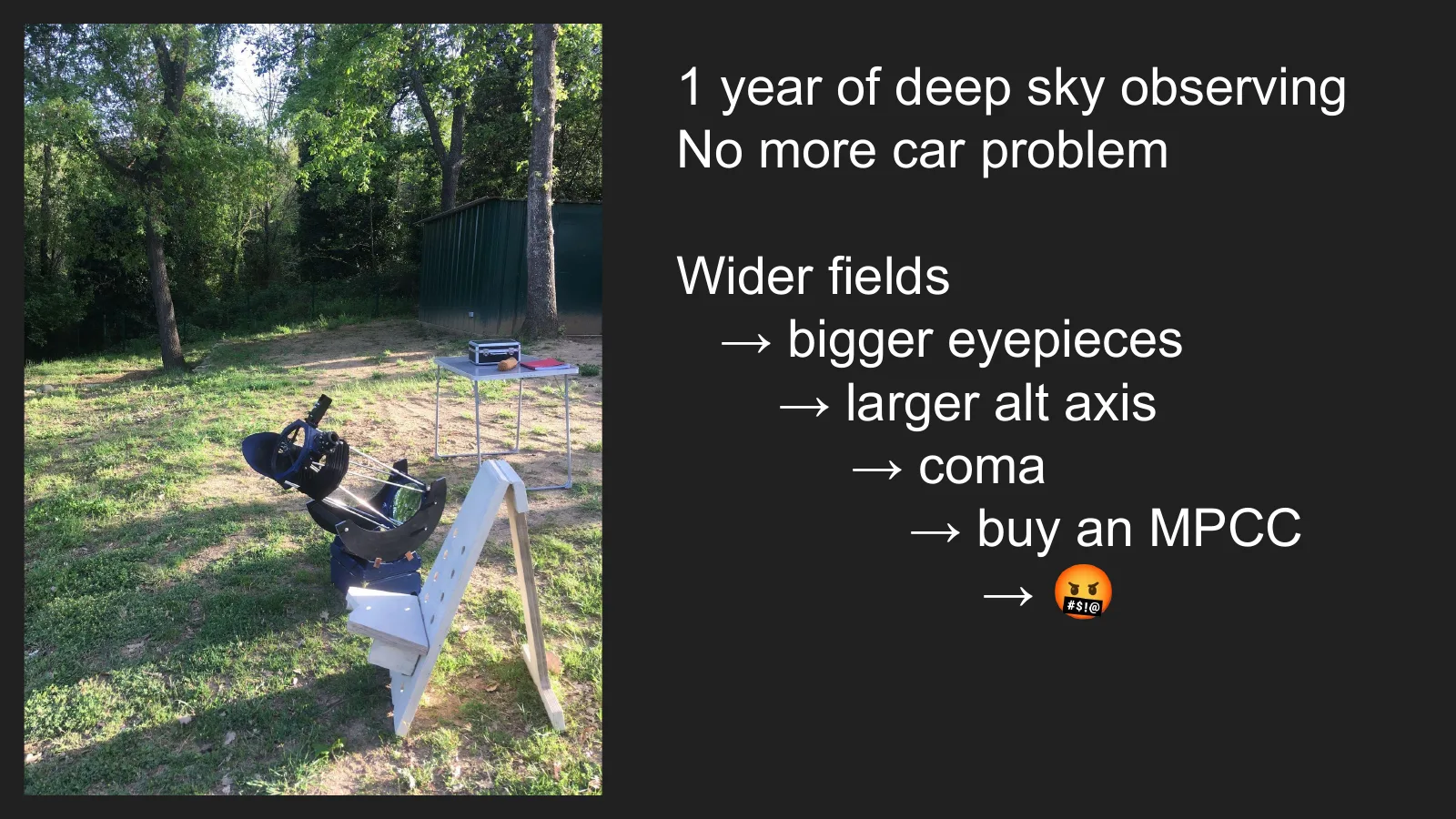
Time passes. I finished the mirror. I have my driving license, I have a car, so I can actually go to Bortle 2, Bortle 3 skies. It’s quite easy in France actually: a one hour drive at the time brought me to Bortle 3, and Bortle 2 was like three to five hours. But it’s possible, you can do it. So I get to darker skies, I want wider fields, I need bigger eyepieces. So I replace the altitude axis with a larger one, so I can have larger eyepieces. I’m bothered by coma. I wrote that I bought an MPCC but it’s a bit wrong, I already had it, but it was very clumsy to use, so I didn’t use it at the start.
And with bigger eyepieces, the problem came back and I wanted to use it. I printed little spacers to use it with my eyepieces, but the result was just bad. In the end, this mirror I spent 18 months on, which gave me quite clear planetary views, was close to garbage with the MPCC.
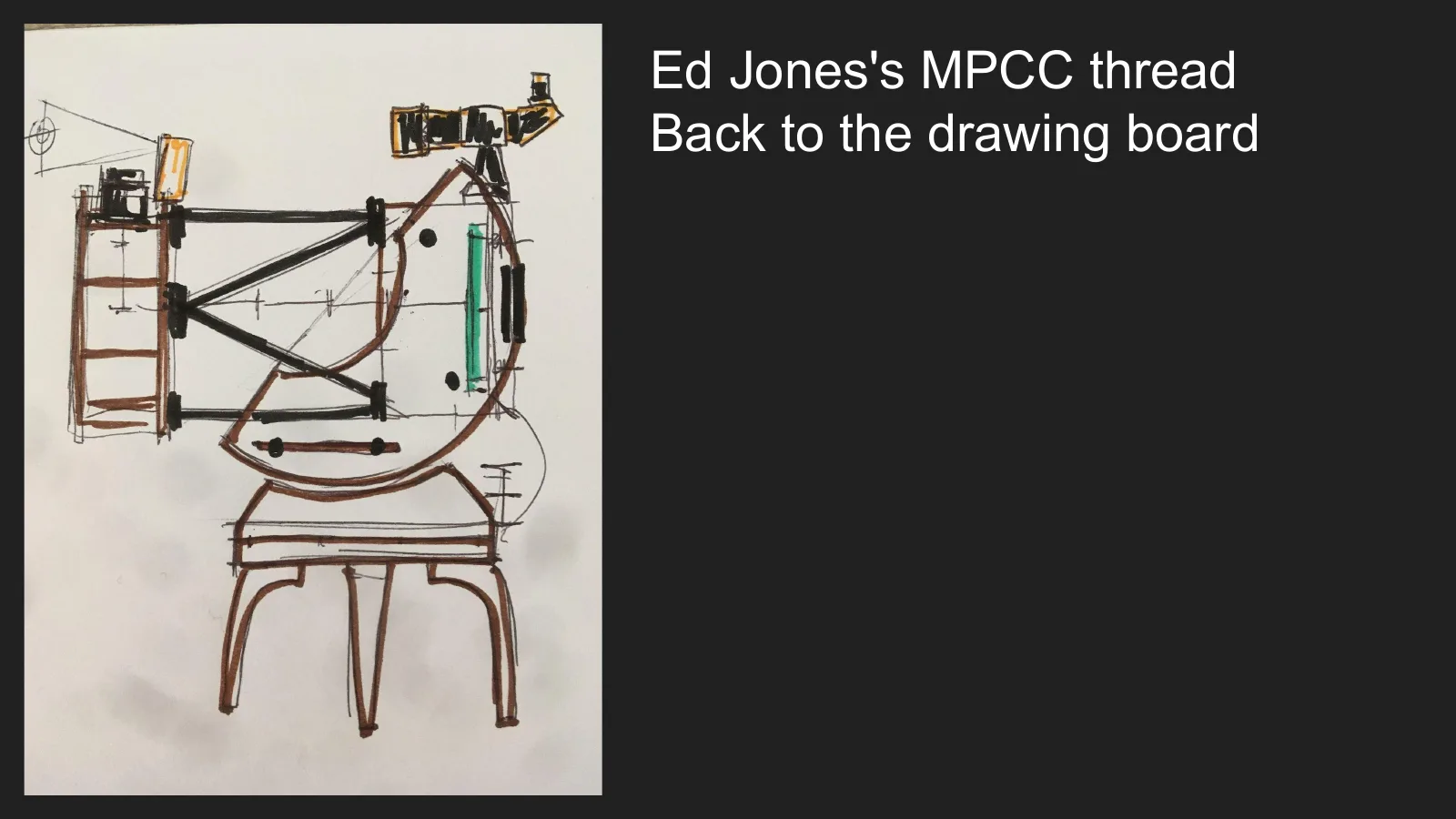
So I was back to the drawing board. I found Ed Jones’s MPCC thread, where he spoke of grinding a mirror for the MPCC. I talked about it to a few friends here, and reactions ranged from “okay, this looks feasible” to “well, people buy correctors to correct a mirror, and now you want to build a mirror to correct a corrector? That sounds a bit silly”. But I wanted to have a go at it since I was stuck. So I didn’t hyperbolize the previous mirror, it stayed that way and went to someone in the Netherlands. I made a second one on the side.
Same diameter, same focal length, because the width of the fields was okay for me, but hyperbolized to -1.33, so 33% deeper than the parabola for the same focal length. The process of making it was a lot smoother than the first one, a bit of knowledge and feel of mirror making had sunk in.
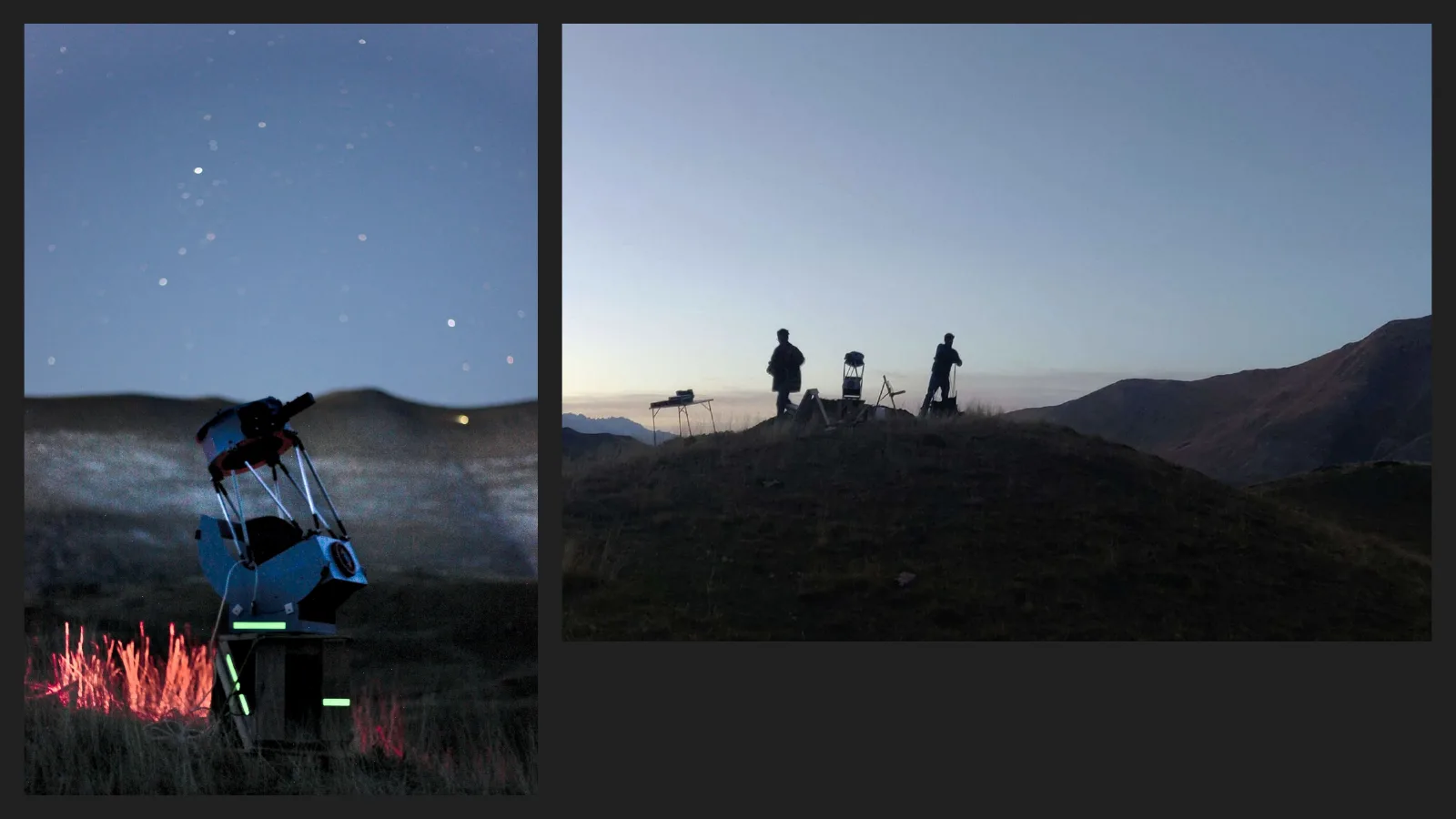
And this one got used quite a lot actually, mainly for deep sky, and sometimes in the mountains in the French Pyrenees. But this kind of astronomy night where you drive six hours or so, I started to see that I did it once or twice a year, and that most of my observing was close to home, or in passing while doing other activities like camping, hiking or even bikepacking. So I wasn’t observing as much as I thought I would be.
Little detail, on the left side you can see my hyperbolic telescope on a “hiss table”, which I got the idea for from a Cloudy Nights thread. It’s like an equatorial platform with a tire inside it, and you control the tracking rate with a little needle valve. It’s called that because you hear the sound of the air moving out of the tire. It tracked for like 45 minutes, then you had to pump air back into it with a bike pump. So it was quite fun, but again, not that practical. And with this wide field, I could point at something, go to a friend’s telescope, come back 15 minutes later, and the object was either not gone or just nearly gone. So tracking was a bit of a distraction, one more piece of hardware to control and think about in the process of going out. So I just abandoned it.
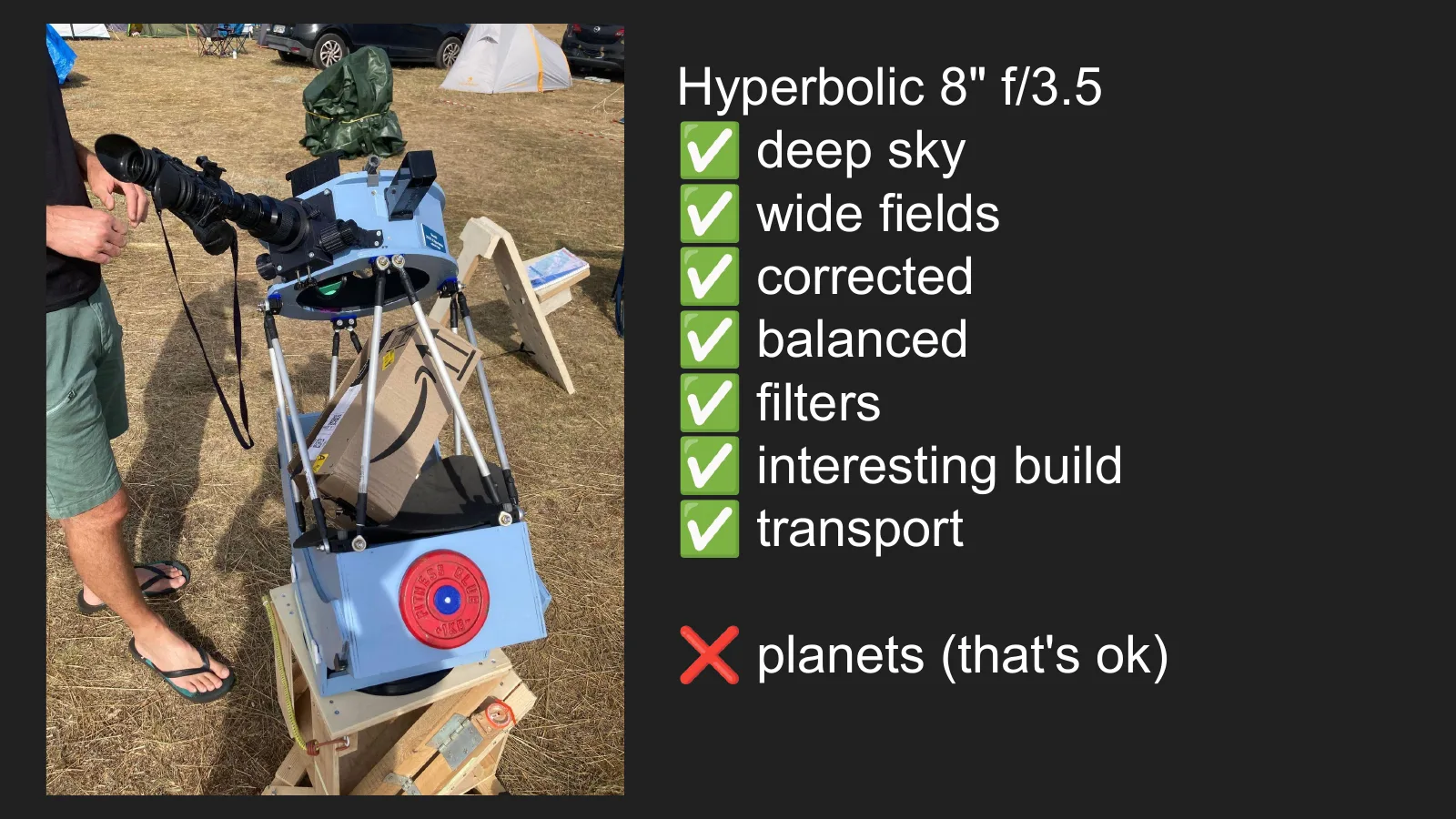
So this one was quite okay with my goals actually. It was optimized for deep sky. It was not good for planets, because the MPCC is still a two-lens corrector and introduces a lot of color: if you point it at Saturn or even the Moon, you can really see red fringing. I’m okay with that because I really don’t do planetary observation, partly because I’m interested in wider fields, and also because I’m not really at ease with small exit pupils. So I just don’t do it. The correction was quite okay. With an APM 20 mm 100°, I feel that the center half of the field is quite sharp, you get a bit of coma, but the field is quite large and the outer half is more like a context for your eyes, you have to look around to see the whole image.
Overall people are quite satisfied with the correction. It was balanced for heavy eyepieces: here we can see a night vision binocular on an Explore Scientific 55 mm eyepiece that someone wanted to try in it. And the build itself was interesting, which is important, because I already knew that building the scopes was taking more than half of my astronomy-related activities, and observing sometimes just doesn’t happen. But you can always grind glass. It had a filter slide, so it was quite perfect for my use and my needs for two years.
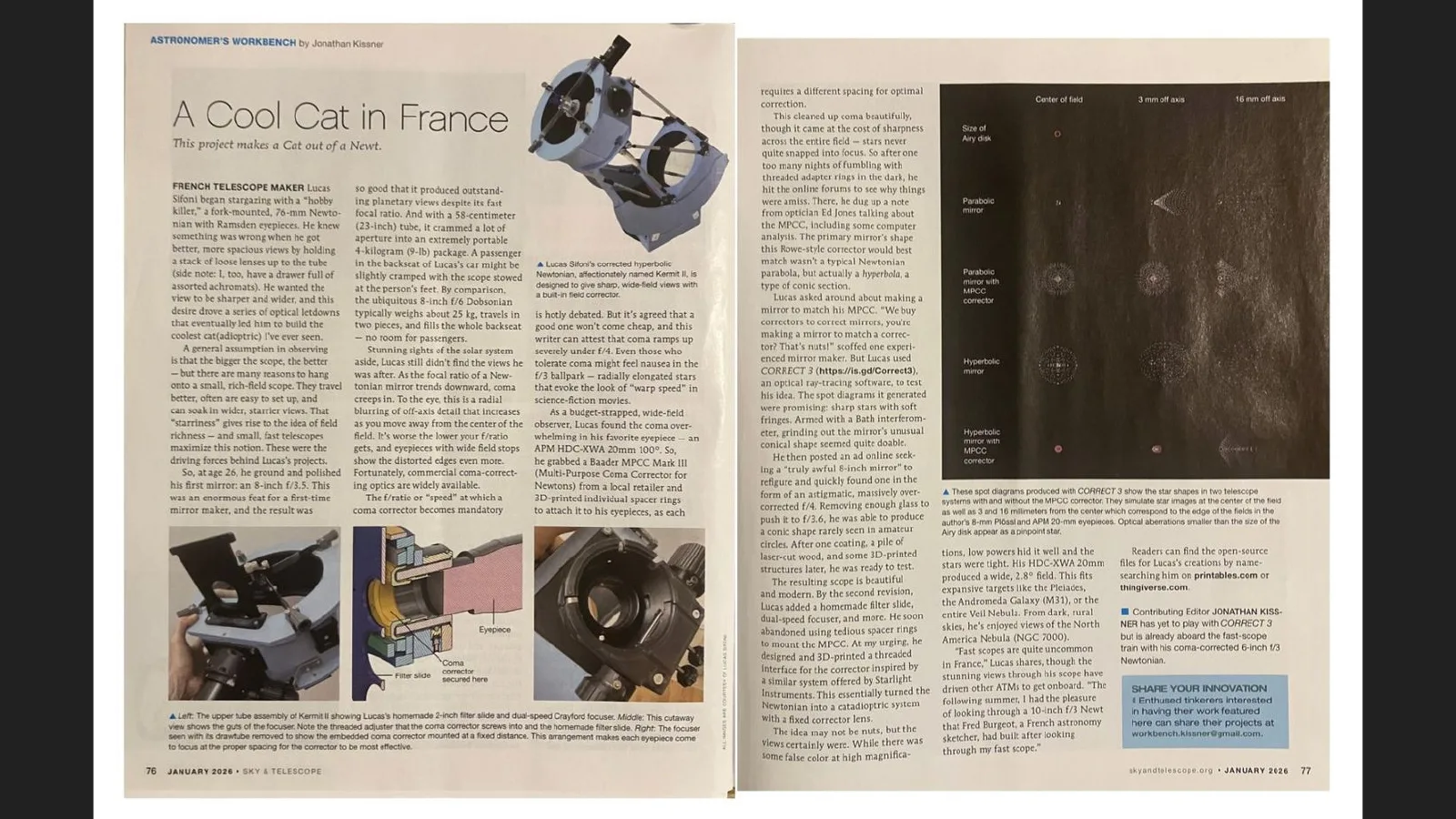
Here’s a screen capture of the Sky & Telescope article. You can see the spot diagrams for the parabolic mirror. The photo is quite bad, but even 16 mm off-axis, we don’t see the spots anymore because they’re so spread out. And we can see that with the hyperbolic mirror and the corrector, the spots are tighter. Stars are still a bit spread at the edge, and you get quite a lot of false color. And the parabolic mirror with the MPCC was just, like I said, garbage. You can barely snap focus, you just have a feeling of something wrong, and it isn’t better than the first telescope on the fork mount that I showed at the start.
So it’s quite viable if you want to have a go at it. You can find MPCCs second hand for almost nothing. Ed also shared another tip that I didn’t try yet: a slightly stronger hyperbola and a slightly reworked lens on the MPCC. You have to disassemble it and repolish one lens a bit, to lengthen its radius of curvature by 4 mm. The spots become a lot tighter, and it could even be viable to observe planets. Tolerances are quite tight too, so I don’t know if anybody really did it or if it was just a paper telescope, but it was drawn.
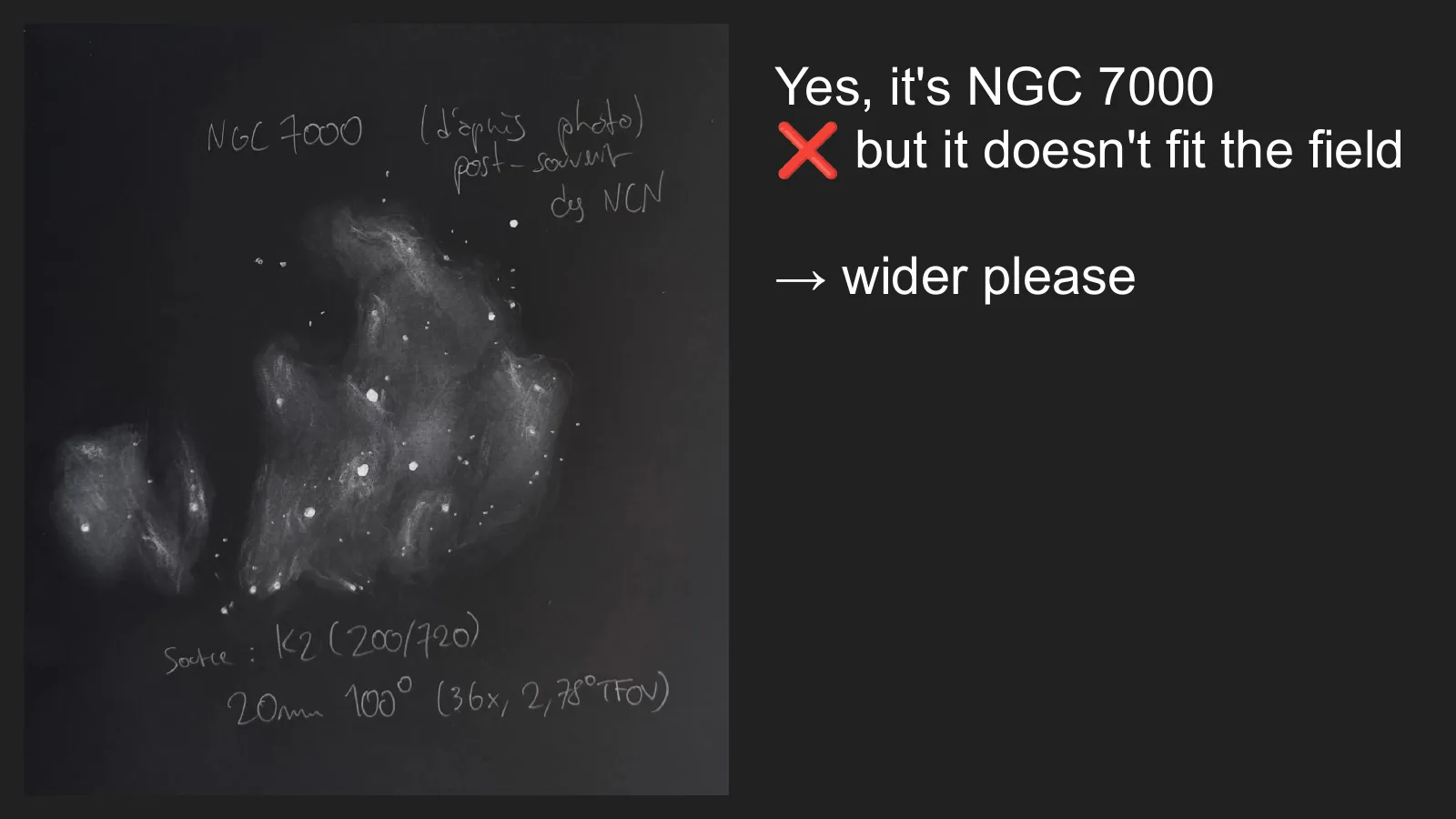
So yeah, I observed with it quite a lot, and had a lot of pleasure on summer objects like NGC 7000, the North America Nebula. But it didn’t fit the field of view, and I was obsessed with wider and wider fields. I couldn’t go wider on the eyepiece side.
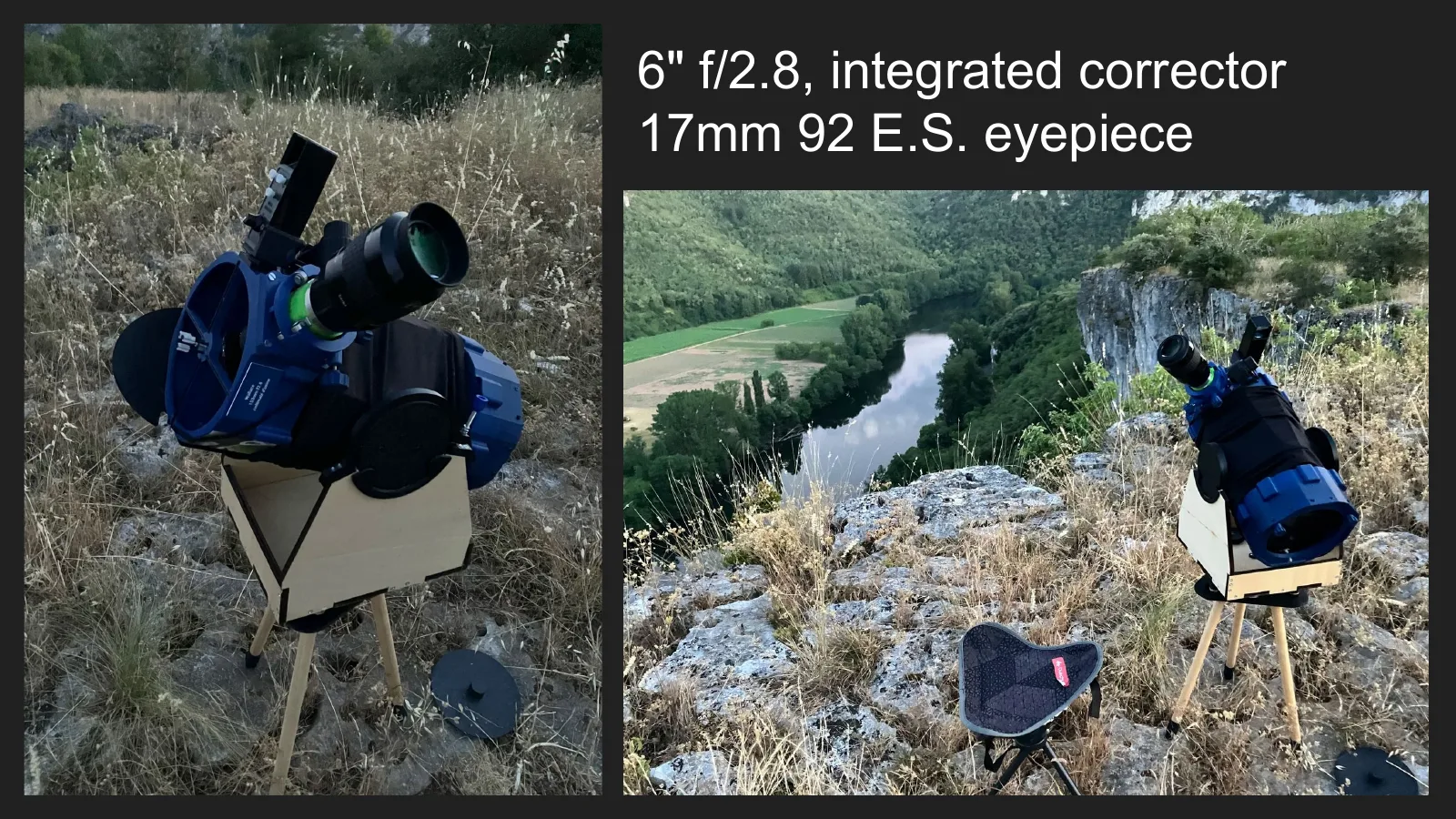
So I decided to go smaller, and I built Wallace, a 6” f/2.8 Newtonian built on a metal dovetail that we can see here, and then two modules with six solid carbon rods. So it’s quite strong. It’s built on a dovetail to become the finder scope of another build I have in progress, you can see the mirror behind me. With this one, I’ve got all my checkboxes ticked. The fields are as wide as I wanted, I can share the views, and it’s quite easy to use.
Friends like it a lot, because you don’t even need to point at something specific, you can just wander in the Milky Way with it. And you will see things that you don’t necessarily see with bigger telescopes, like the Sagittarius star clouds, or subtle nuances in the background glow of the Milky Way where stars don’t resolve. So it’s a different kind of observing, and it circles back to Mel’s original drawing, which inspired me to start building. Like I said, I don’t really do serious observing anymore. I mainly sit in the night with this kind of telescope, and I will spend like 45 minutes on M31, which is an easy and bright object. But the more time you spend on it, the more detail and nuances you get.
I’m not the kind of observer who is pushing the envelope of his visual acuity or detection capacity. Hard to see objects are really hard to see for me, and I enjoy that less than deep wide views with better detail and more light than in small binoculars.
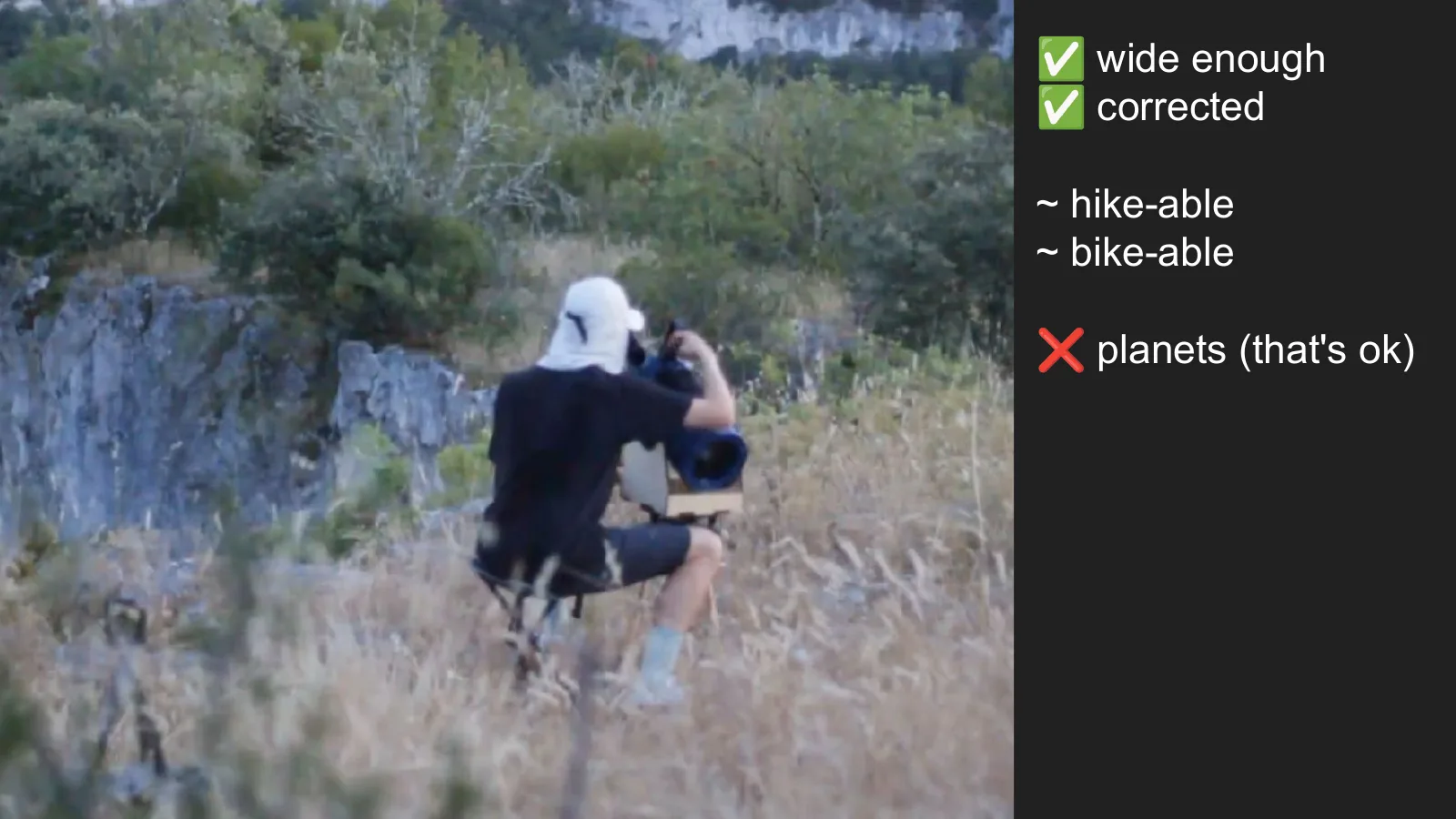
So it’s wide enough, it’s corrected, it’s not really great for planets. I can hike with it, this photo was taken during a hike. I can bike with it too, but it’s a bit of an afterthought, it’s not really made for that. Here we can see a little backpack attachment to transport the rocker, and this part is 3D printed and disassembled. So yeah, with a bit of effort I can shove it in my backpack, but it’s not made for that either.
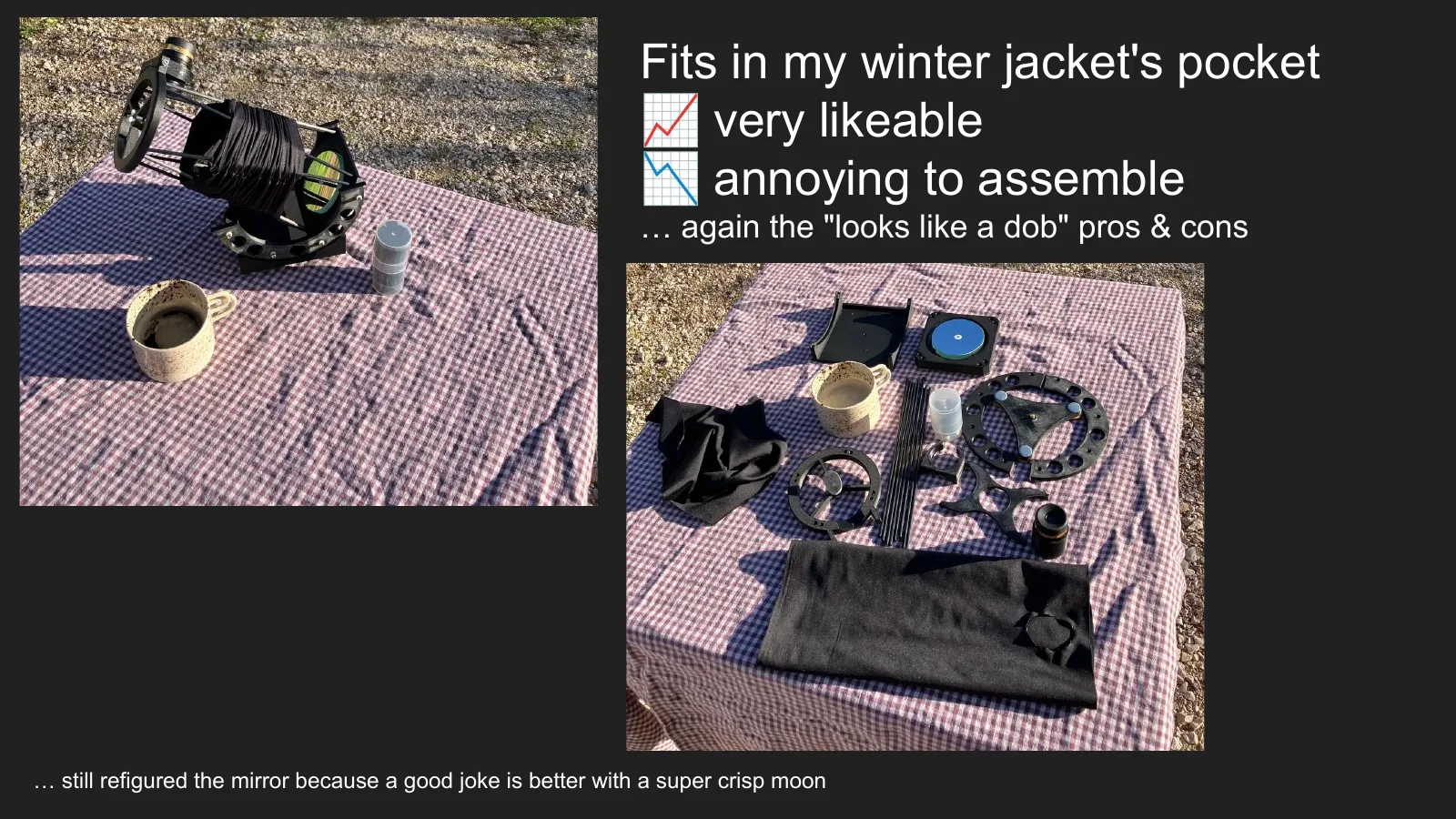
Afterwards, on a plane to Norway, I was thinking that it would have been great to have a telescope with me. I didn’t. So I used the plane trip to draw a new telescope, and this one is quite fun. It’s a 3” with a 300 mm focal length. It has the form factor of a real Dobson but it’s really small. People quite liked it, and I refigured the mirror: the joke of getting a really tiny telescope out of a large jacket pocket and having it beat a commercial Newtonian next to it is quite fun. You get really crisp Moon views in it, but it’s very fiddly, I use the tension of the rods themselves to position the various parts.
So it’s not super easy to assemble, it takes five minutes. Collimation is possible but a bit fiddly. I think I lost more than I gained here by copying the form factor of a real Dobson. If you want something really mobile, you can do a lot better than that. It has a bit of a weird status, more like a decoration piece that can observe than a real telescope made for going out with. But you can transport it. I’m not super satisfied with it. It’s fun, it’s nice to look at, but it doesn’t have a real purpose, that’s what I mean.
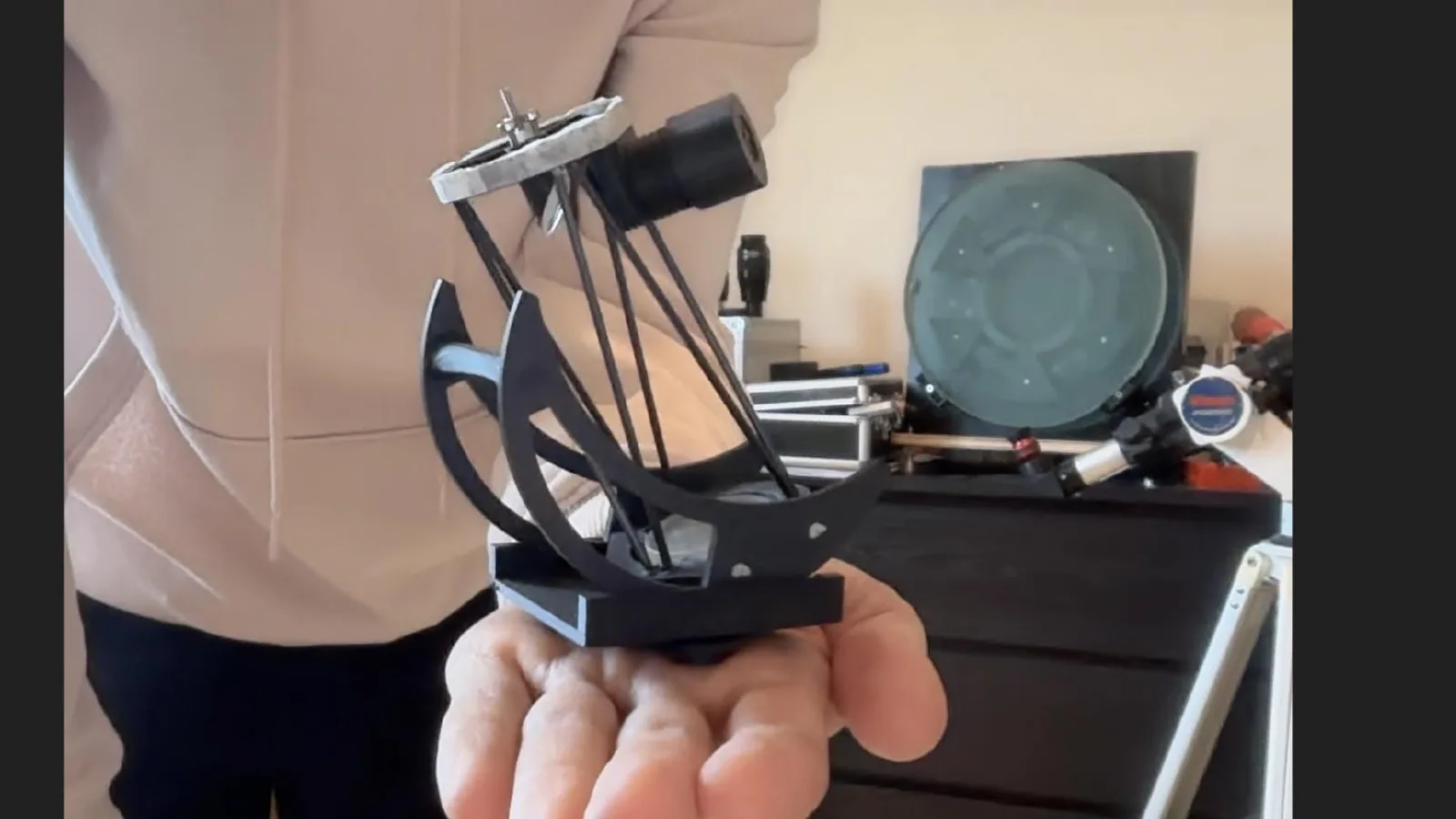
Next is the 28 mm Dobson. This is the joke pushed to its conclusion, I won’t go smaller.
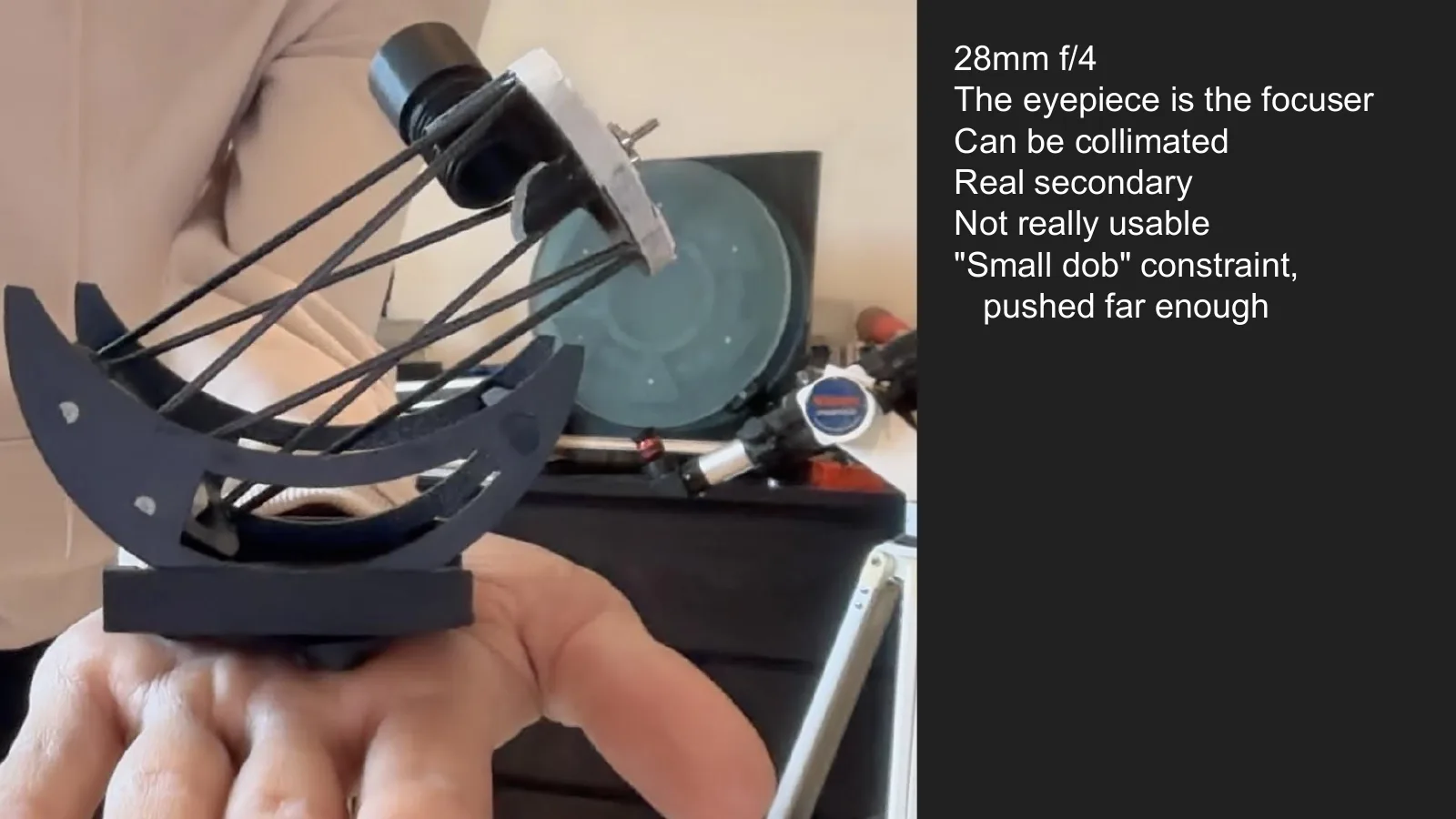
It’s a 28 mm f/4 telescope with a real secondary mirror that a friend accepted to cut and polish for me. The eyepiece is a 10 mm, which is also the focuser, there’s no separate focuser. This one really is a joke, because I always got comments about always shrinking scopes, so I shrank it all the way down. But it’s really hard to use and see something in it, because it’s so tiny and fiddly. And behind it is the 16.5” porthole blank that was sold to me by Zane, which will become a 16.5” f/2.8 telescope. It will be the big telescope on which this one is supposed to be mounted.
So despite going smaller, I still have plans for a real light bucket with a short focal ratio, to use once or twice a year at star parties. I’m okay to put in this effort even if it’s for twice a year.
But I’ve found that the standard dob, or the standard f/5 to f/6 mirror, just doesn’t really work for me. I don’t have any interest in planets, and the standard scope, even the process of building it, doesn’t really appeal to me. I built a few other telescopes that I didn’t show here, standard dobs with f/5 or f/6 mirrors, and I didn’t really use them. I just gifted them to friends. So by following the standard shape of what a telescope should be, I’ve built scopes that didn’t get used, by me at least.
So, putting aside everything that didn’t work, I have mainly three goals in astronomical observing. For the widest fields, Wallace, the small 6” f/2.8, is okay. For more aperture, Gromit, which will be the big one, will do it. Always a telescope in my bag: the small one sort of does it. It’s a bit annoying to mount, but it’s okay. And what I still like about it, even if it’s fiddly, is that it has the potential to show how a telescope works when I take it out. If I say to a friend who isn’t into astronomy “hey, would you look at the Moon through a pair of binoculars?”, they get less interested than by seeing a very small telescope coming out of the bag. “Wow, I didn’t know you could make a telescope that small. How does it work? Why do you align the mirrors?”
So it has a bit of didactic potential, and I quite like this aspect of it. So those goals are fulfilled.
But my other goals, linked to what I actually do during the year, are not fulfilled. I would like a telescope that I can take camping with a bike, that I can take on night-long hikes, which I do, or even on longish distance trail runs, which I find myself doing more and more while AI becomes more and more prevalent in my work. Maybe there’s a link, maybe not. Those specialized instruments would not have the goal of being useful or usable by someone else, because I think doing something that everyone can use widens the design space a bit too much, and you lose the potential of being more radical in the shapes and in what you don’t include.
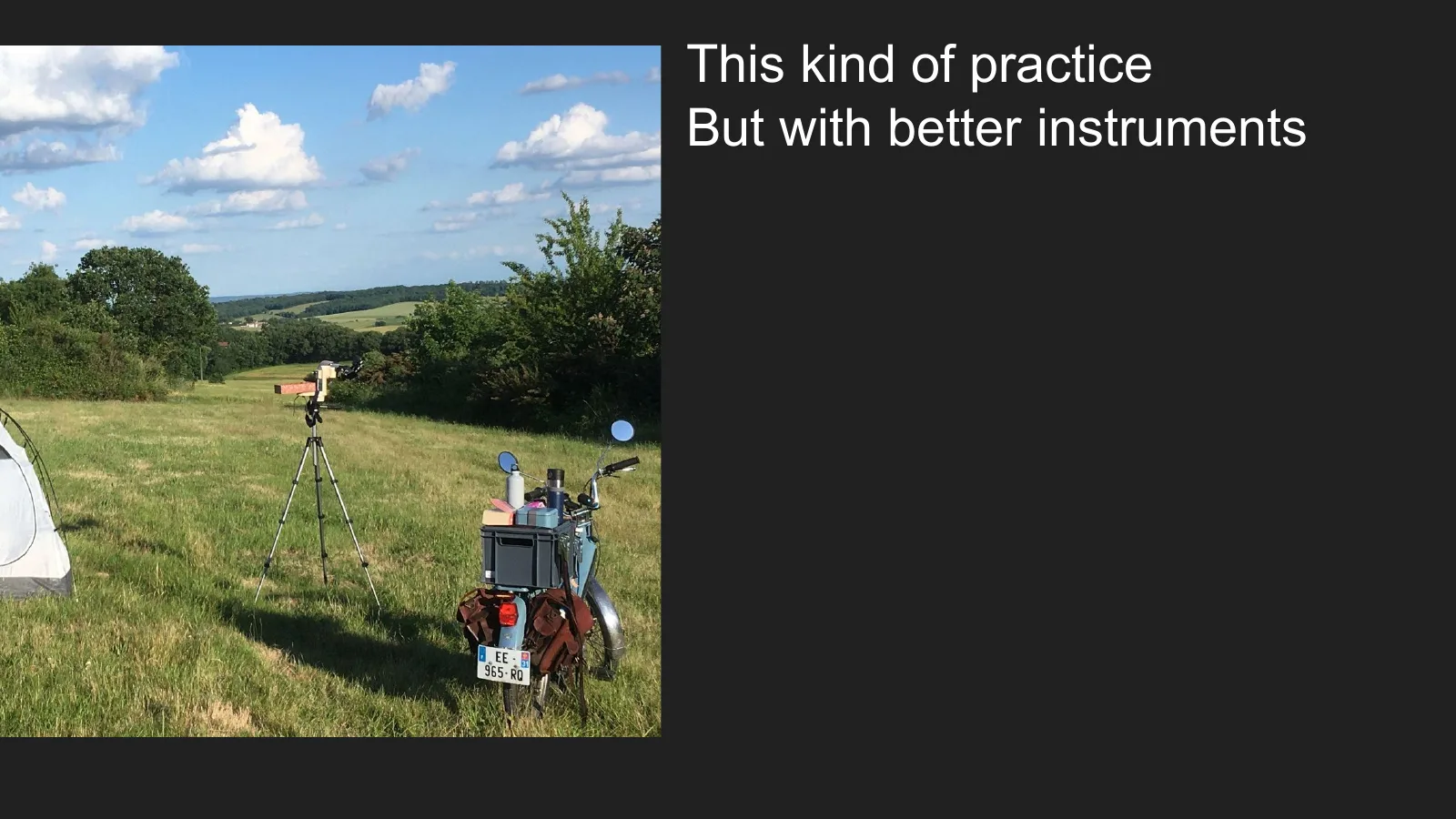
So my new goal, if we put aside the current mirrors and scopes in progress, will be to replicate this setup, which was very lightweight, very mobile and quite minimal, but with better instruments, suited to the specific conditions in which I’m outside at night.
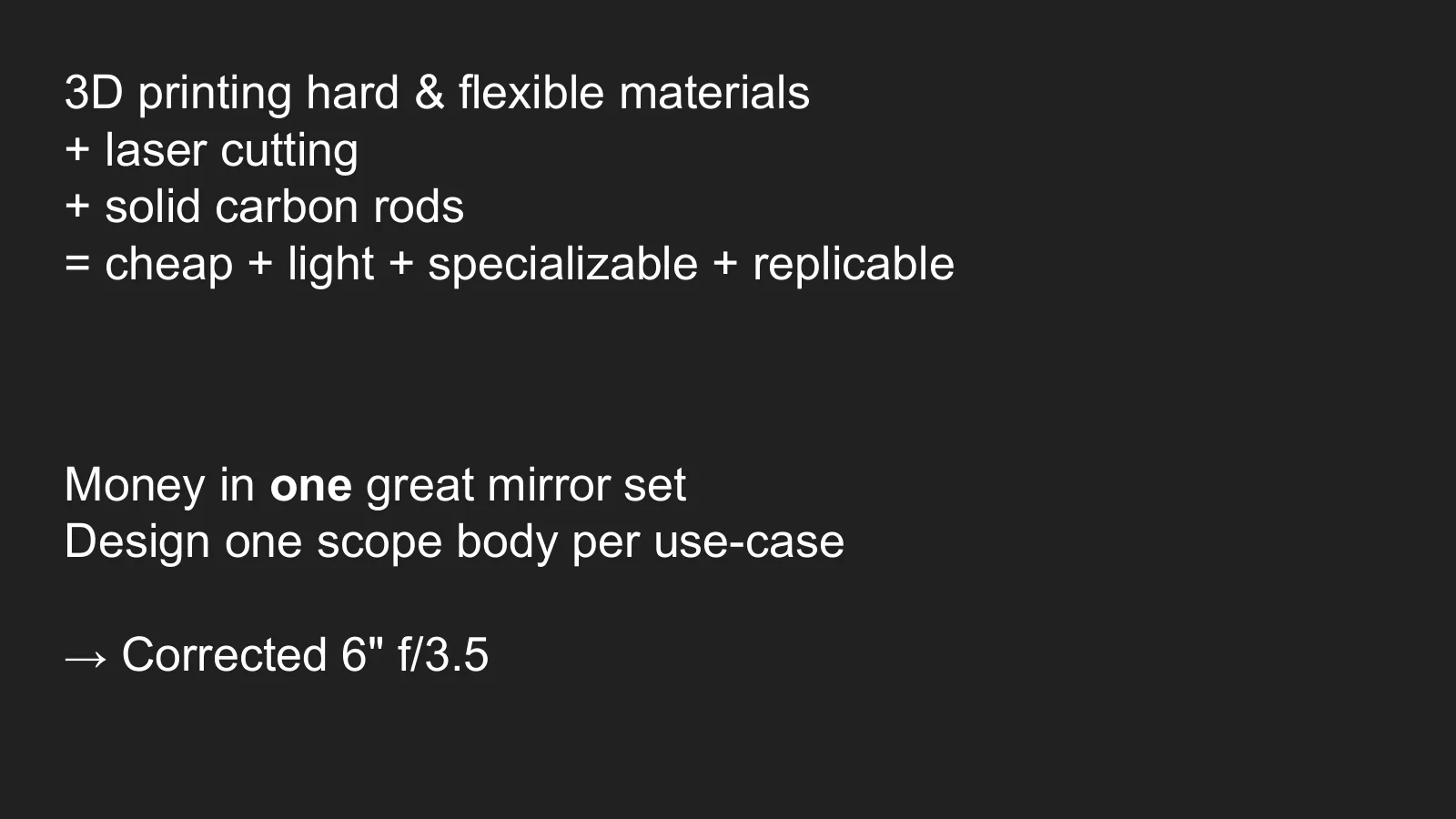
I didn’t speak of the builds themselves, but most of them use a lot of 3D printing, because that’s a tool I’ve been using for a long time now. I also use laser cutting for wood panels, because laser cutters are more precise than me. I don’t own one, but there are services near me and they’re quite cheap. Solid carbon rods are very cheap too. So we have the potential, I think, to have multiple bodies for one mirror set, which would be very mobile and still allow for wide views. This is very early in my process, but I’m settling for a corrected 6” f/3.5 with an MPCC. Again, I’m on the verge of going for the modified MPCC, but I’m not sure about that.
Why the MPCC and not the four-element GSO corrector that I have in Wallace? Just because of the weight: the MPCC is lighter, shorter, more compact. And by the way, the GSO four-element corrector, which was designed by Roger Ceragioli, is quite underrated. If I go back to Wallace, it has this corrector, we can see just a bit of it peeking out in the light path, and I’m using it exclusively with this 17 mm eyepiece. I mentioned it to various friends who observe and they were a bit doubtful about it, but the correction is quite great, and it logically has a lot less false color than the MPCC.
So if you want to build very small, very wide field telescopes, this corrector can take quite short focal ratios, on the condition that you space it correctly. It’s mostly sold with an eyepiece holder that positions the eyepiece at 55 mm of back focus, which is very wrong for it. There are threads on Cloudy Nights with the corrector designer giving information on how to space it correctly, and when you get the right back focus it has a lot of punch for its price. To put it simply: don’t discount it, it’s not the Paracorr, but it has some power. So, I’m going for a hyperbolic 6” Newtonian.
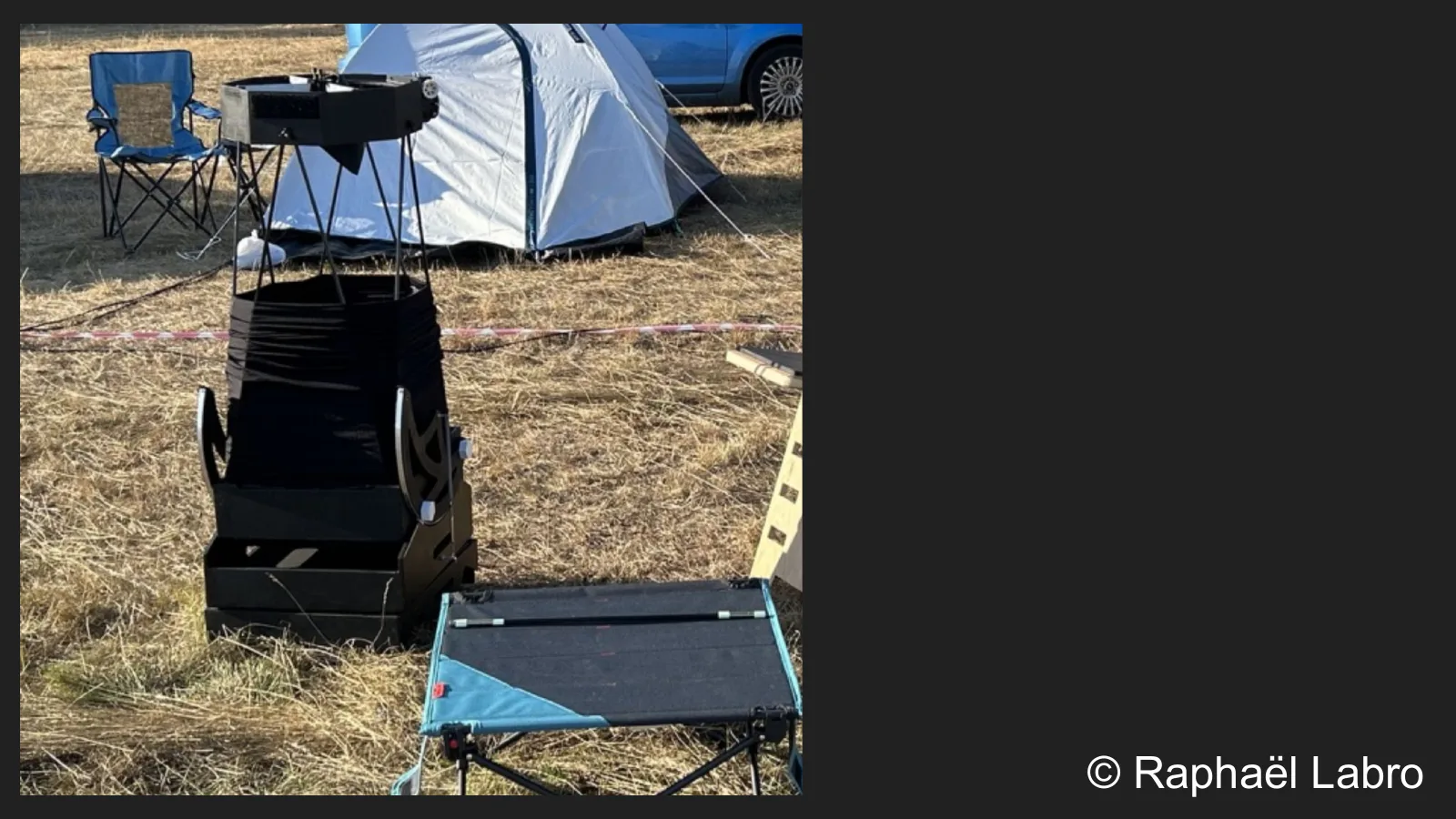
Oh yeah, I forgot about that. I’m not the only one in my circle to go through this kind of process about telescopes that get used or don’t. This one is a 12” f/4 for which Raphaël made the mirror, and he built the classical French telescope for it.
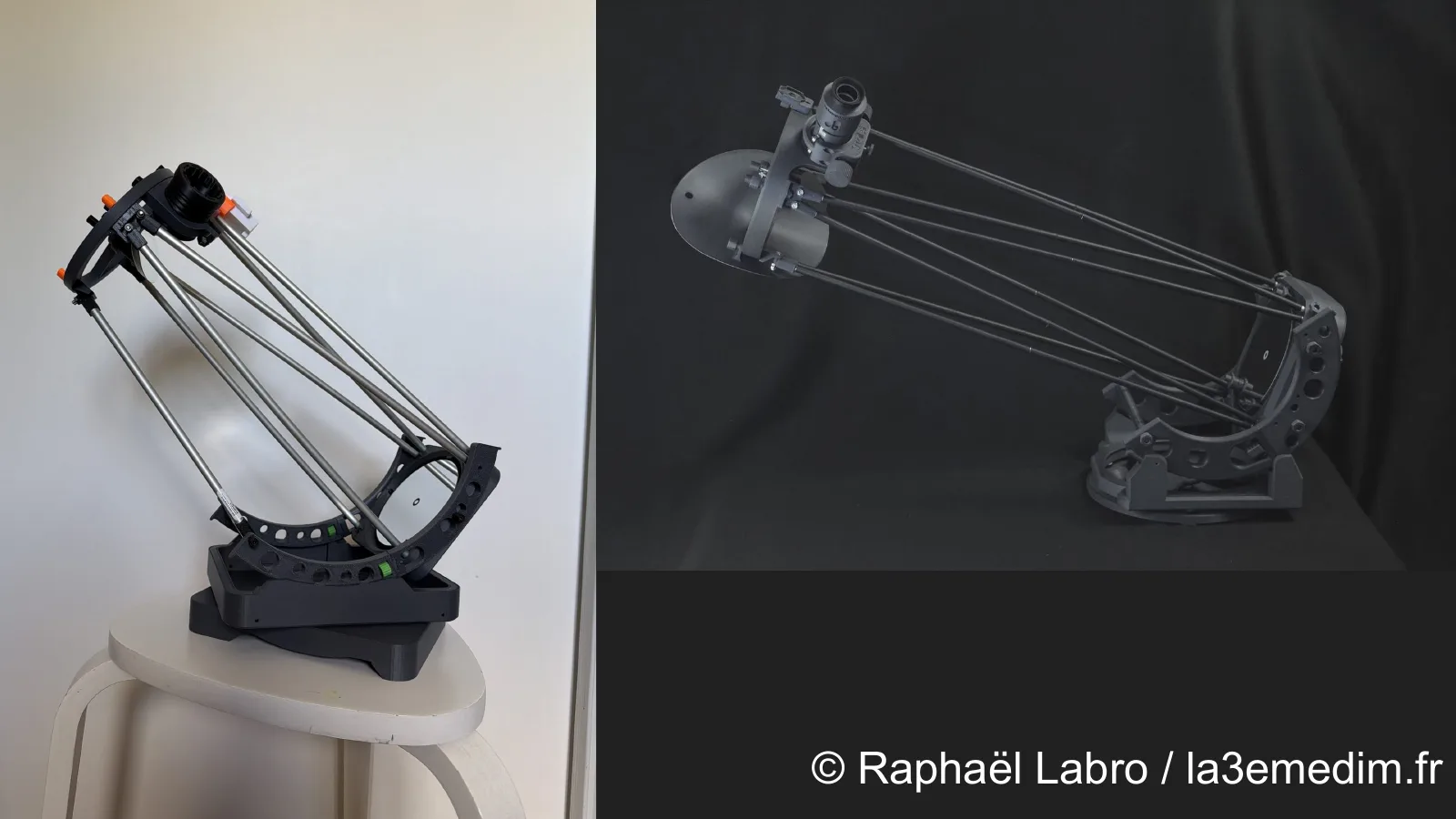
But he found himself not using it that much, and now he’s building, maybe you’ve seen them online, the Smallest, which is an open source design that he also sells, and he’s working on even smaller telescopes, this one is 4.5”. So we found a difference between our observing intentions and what life, mainly work, and just the balance allow. It’s not that we can’t observe, it’s that what we choose to do isn’t really suited to big instruments that go out once or twice a year. And this kind of small scope that can go out quickly is quite nice for us.
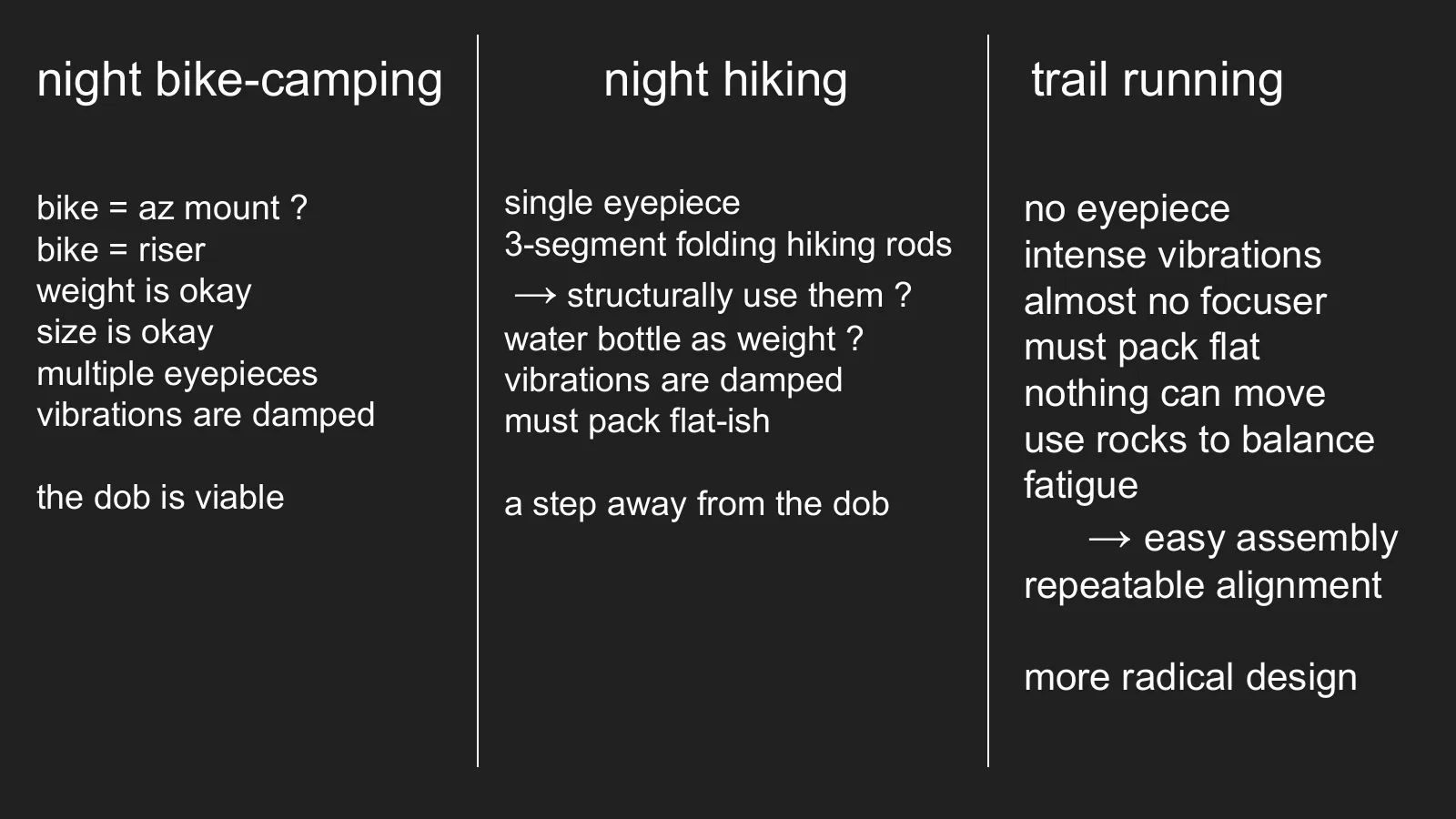
So for the three uses I’m imagining, I figure that there are different constraints. The bike one is the easiest, because the bike bears the weight, so it’s not really a problem. And if you’re creative, you can even see the bike as an azimuth mount, if you have a handlebar that can pivot a bit more than 180 degrees. When hiking, I have three-segment poles, two of them, which makes six carbon tubes. Maybe I can reuse them. It will be a bit weird in terms of shape, but maybe that can work. Maybe I can have a support for my water bottle to balance the telescope. There’s no vibration problem in transport while hiking, but it should pack flat, whereas on the bike it’s not a problem, you can even do a dob.
For running it gets a bit harder. Oh, I wrote “no eyepiece”, that’s a mistake. I would go for something a lot lighter, maybe no focuser, meaning that a modified eyepiece becomes the focuser body. You have only one eyepiece, and it’s okay because you’re in the middle of an exercise, but it’s night, you can stop for a short pause and take in a bit of deep sky for 15 minutes. Today I just stop to look at the sky, and that’s quite nice. I’ve started to try to build little nets in TPU, which is a flexible thermoplastic, to put rocks in.
The idea would be to use them as wrapping nets for the pack, acting as a case, a bit like a phone case in case of shock. But you would use it while tired, so it should be easy to assemble. Well, that’s a lot of constraints. I have no idea about the shape today, but it will certainly be a bit weird compared to a dob.
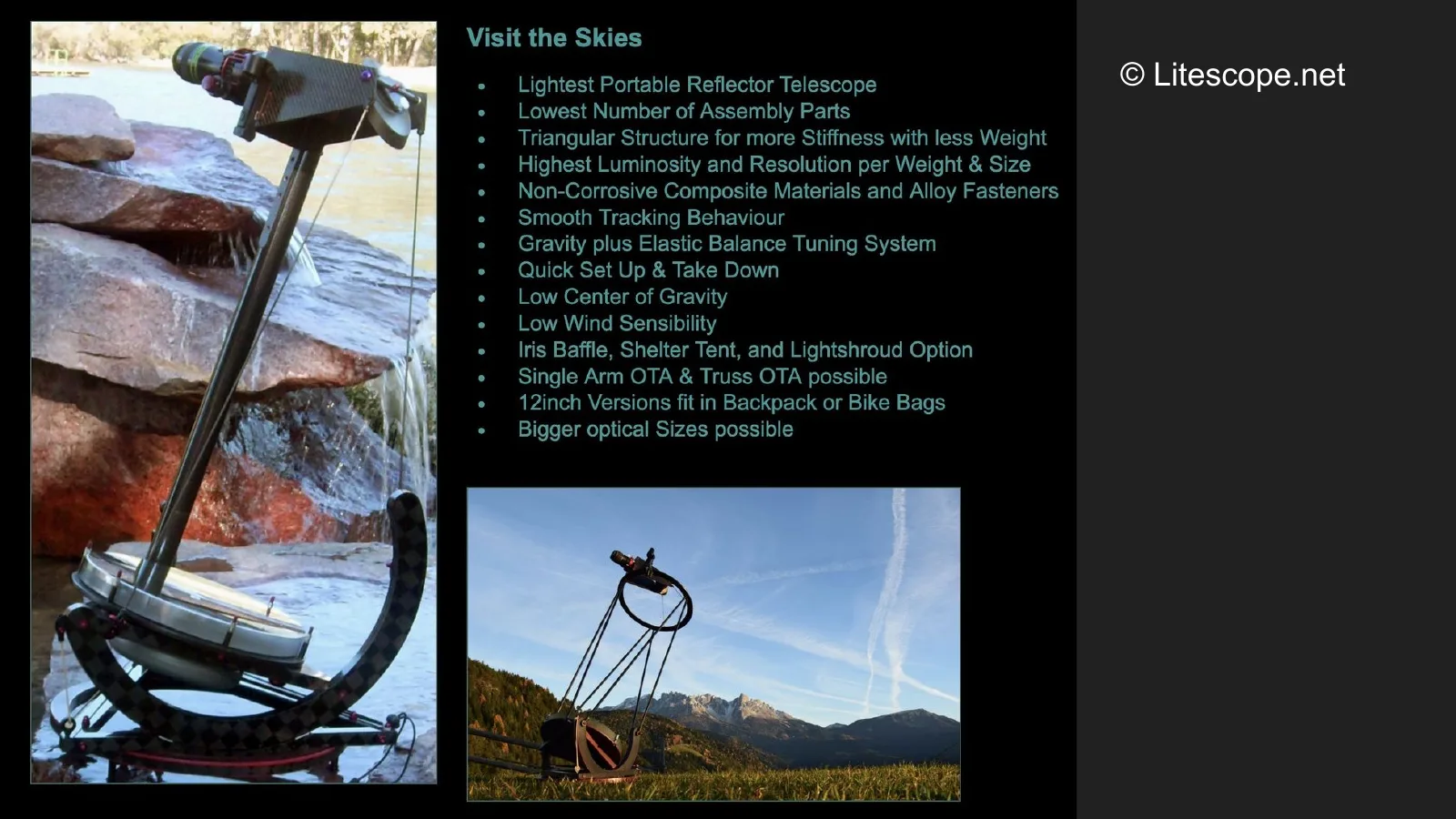
I’ve seen this one online. I don’t know if it’s great in practice or not, but it looks great to me for this use, and I find it illustrates quite well my thoughts of a telescope that not everybody can use, because the mirror is exposed and it’s a bit at risk. You have to know what you’re doing, but it’s yours, you know why you’re taking it, and you know what its shortcomings are, so it’s not a problem. But it can do everything.
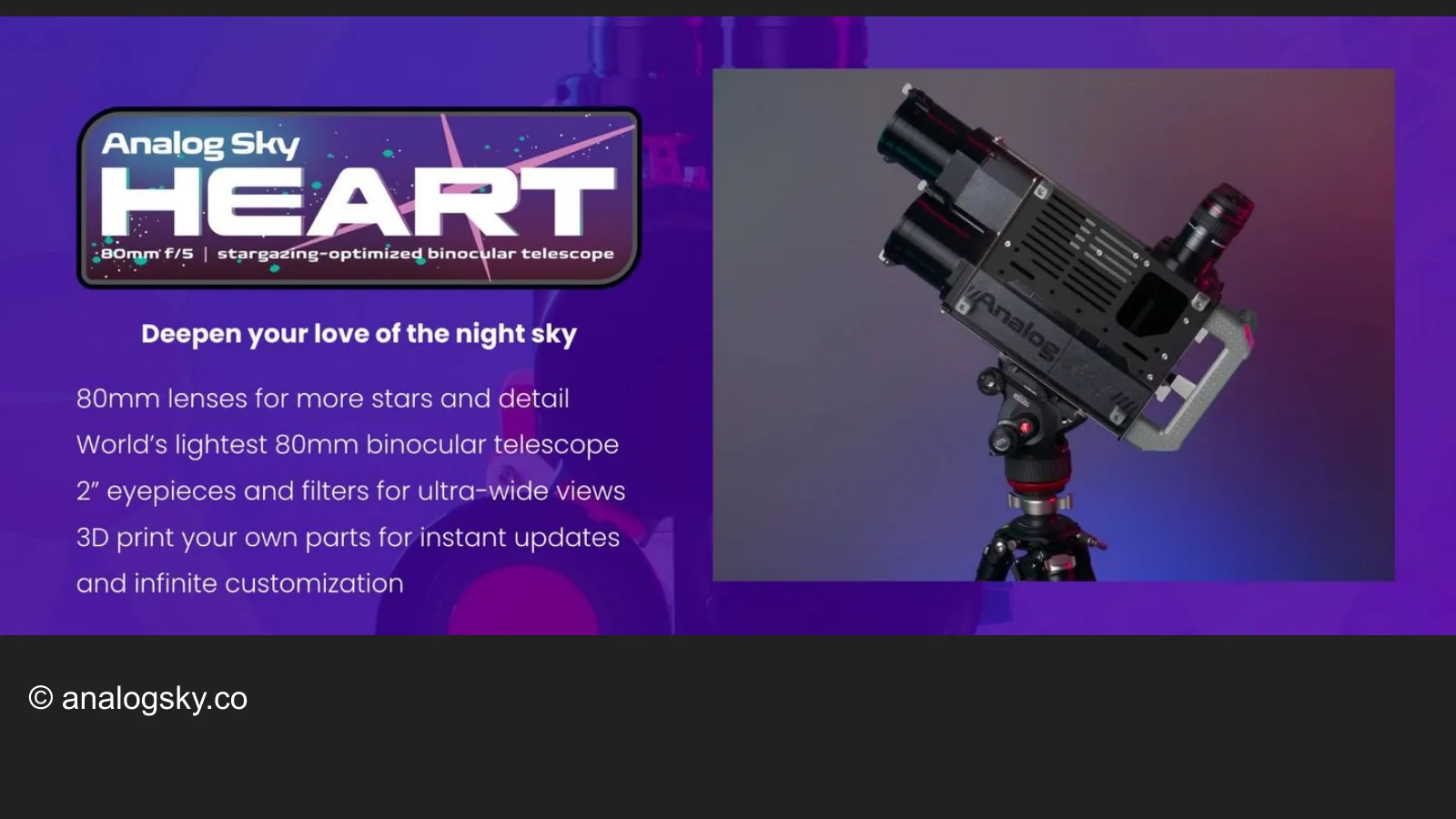
And I’m a big fan of Robert’s work too, because I find his design work to be really free from previous work in astronomical instruments. I don’t know if you’re there, Robert, but if you are: I found your presentation about your design process, putting in tangible controls and taking inspiration from Cowboy Bebop or that kind of aesthetic, quite refreshing, because this doesn’t look like anything else. So I guess it must be a joy to own, and to design as the maker. So props for that.
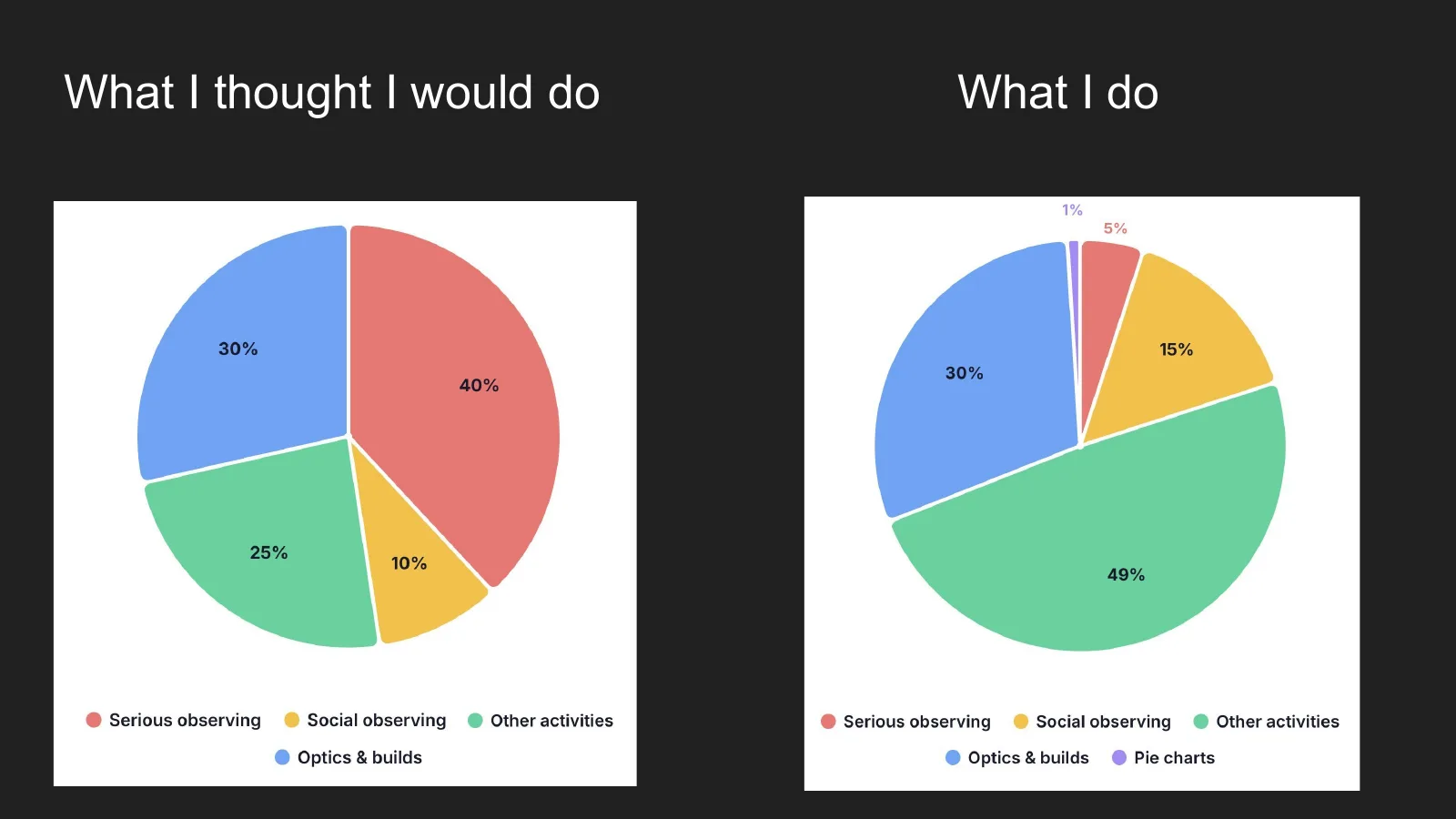
To summarize what I wanted to talk about: I built my first instruments thinking that I would dedicate most of my free time to serious observing. In practice, I almost don’t do it. And when I go to star parties, I take a friend who doesn’t do astronomy at all and I show them around, I help them discover the night sky. So it’s more of a social activity. What’s constant is building and doing optics. I don’t stop doing it, and it’s about the same portion of my time. But my observing needs aren’t what I thought they would be. I started thinking that I would need a bigger dob, then a bigger dob, then why not another bigger dob, and with a bit of hindsight, just not that. So my thought and design process is moving a bit away from that.
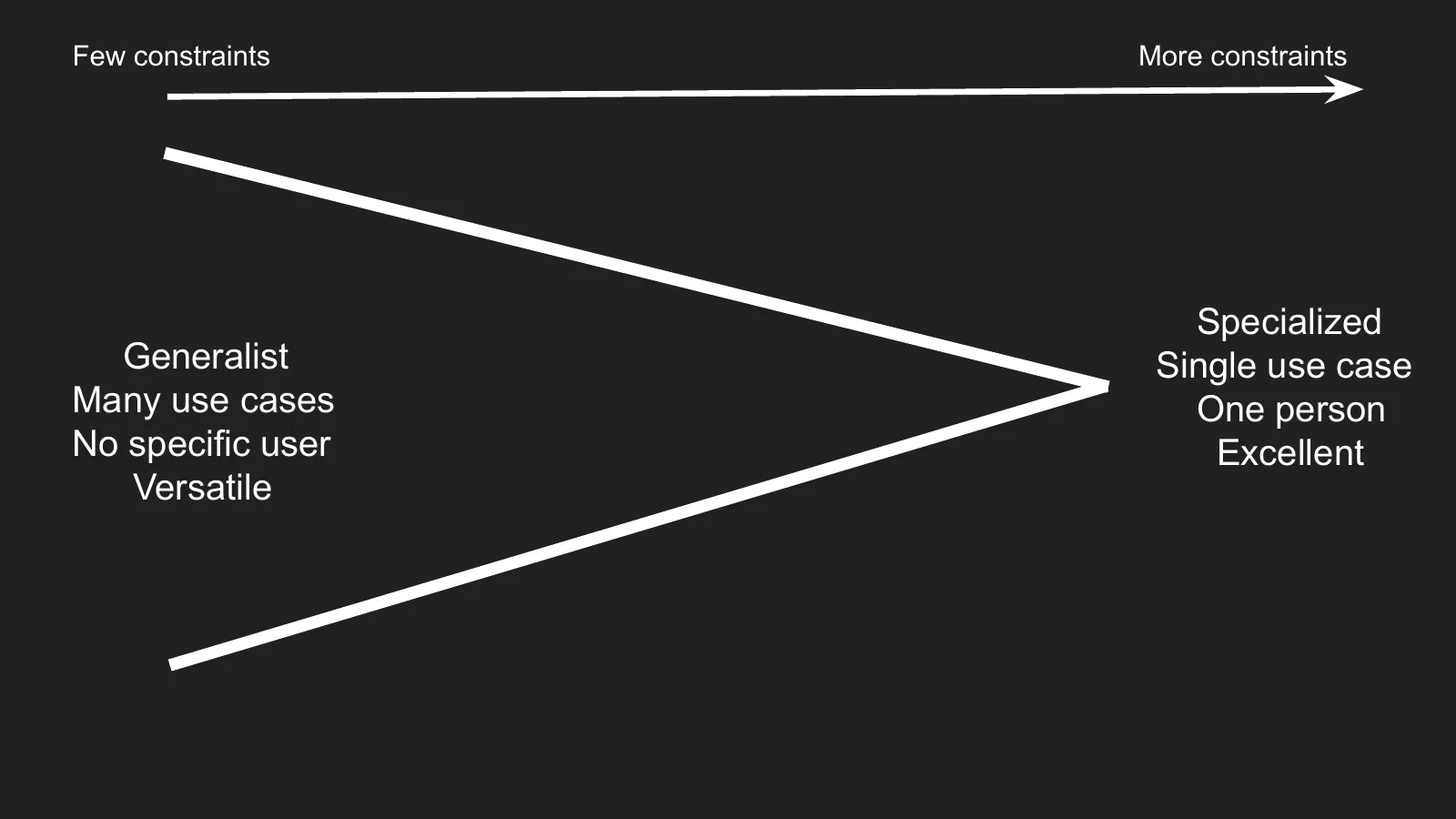
And by adding constraints, I think you can do things that are excellent in one specific area, if you build mainly for yourself instead of doing something that everybody will like and use. It’s okay to build selfish telescopes in some way.
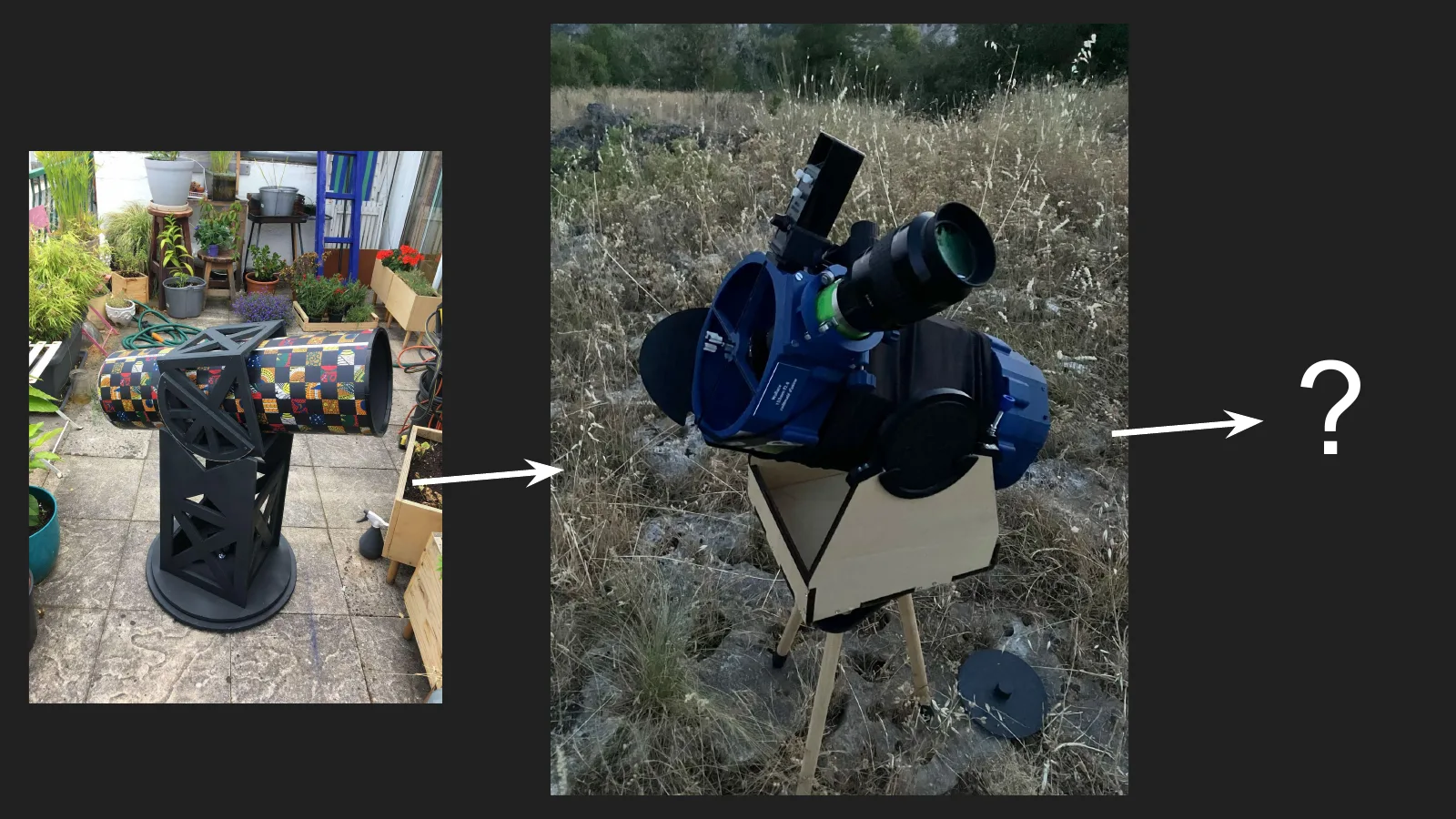
So this was the evolution over a few years. Now I want to mix astronomy with general outdoor activities, I don’t want to be outside at night without a telescope anymore, and that implies building telescopes that allow that. At the same time, I’m okay with a bit less performance or focus in my other activities by putting a bit of astronomy in them. And the existing designs are not made for that.
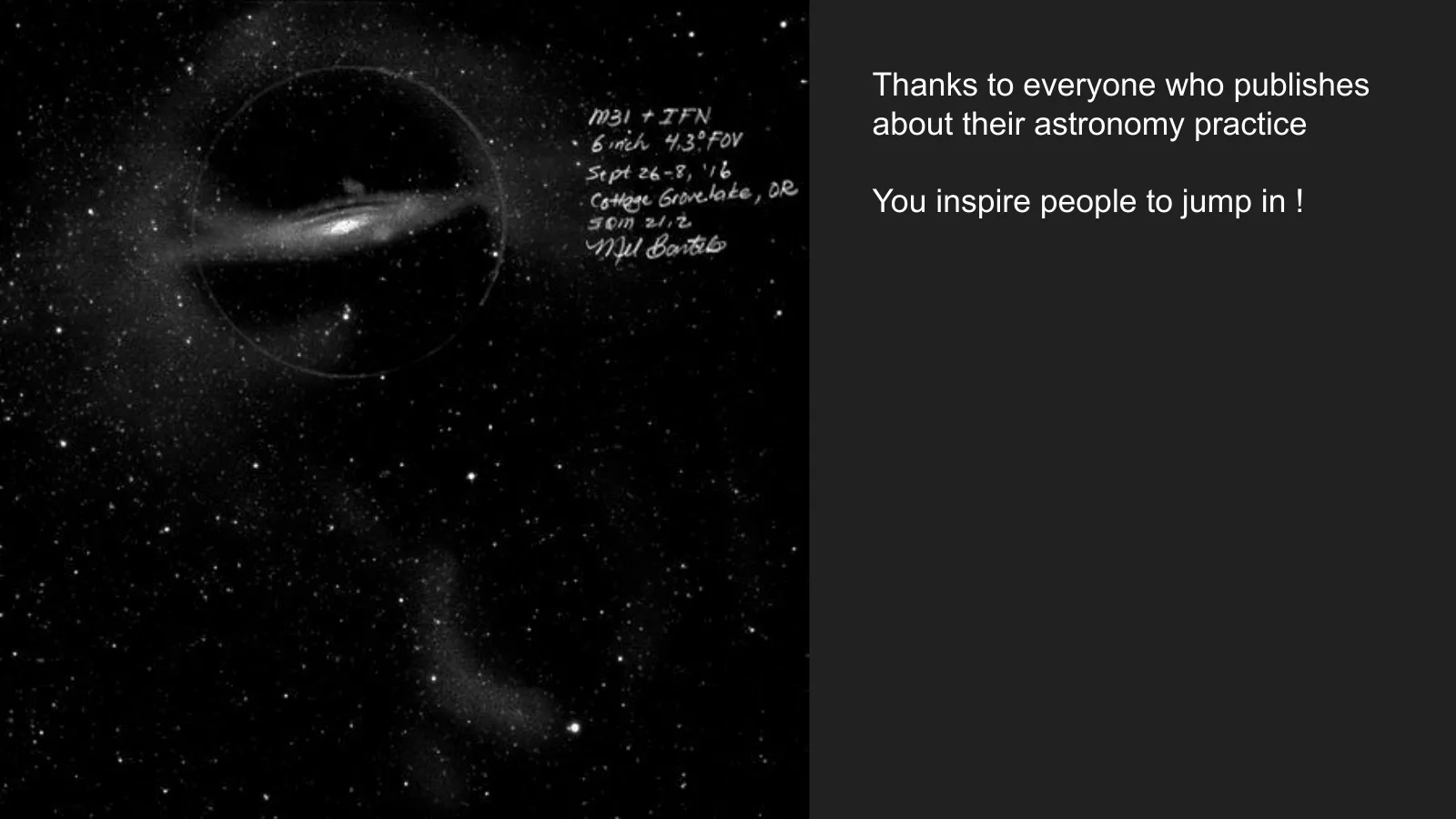
So, thanks to everyone who publishes online about what they’re doing. I think you’re doing a great service in helping renew the builders, and the generations of people who share. So if you see this video and haven’t started, maybe you could do one. And if you share, just keep sharing. It’s a virtuous circle. Thanks for your attention, I hope my French [English] was okay. And I will stop the screen share.
Q&A
[Host] All right. Thank you so much, Lucas. That was a really inspiring way to start our day here today. Really thinking deeply about how we’re observing, why we are, and what our own personal goals are for telescope building and for observing, all wrapped up in one. So, I love that.
[Audience] Speak up. I can barely hear you.
[Host] You can barely hear me? Well, I’m trying to keep it low for the microphone. Sorry. Great job, Lucas. I’m gonna open it up to questions for everybody here. We’ve got a question here. I want to remind everyone joining us online that you can type questions into the chat, and I will read them for posterity, and then Lucas can answer those. So I’m gonna hand it over.
[Audience] Okay, thank you. Hi Lucas, very nice presentation. The one question that comes to mind: you’ve gone through a lot of struggles trying to use an MPCC, you refigured a mirror, and I understand the dichotomy of refiguring a mirror so the corrector corrects properly. Have you considered using Houdini eyepieces instead, and not having a corrector at all?
[Lucas] Yeah, it’s right, I didn’t speak about Houdini. All that work took place in the years before he introduced them, and I find his offer really interesting. I’ve tried them a bit and they are excellent eyepieces. I think I’m stuck in the pre-Houdini state of mind, where I’m thinking of correctors, and I have my eyepiece set and my favorite ones. So you’re right to nudge me in this direction, because I didn’t even consider it for the next build. Maybe also because I just found a Paracorr 2, so it goes in the direction of keeping my eyepiece set. But for a lightweight, corrected, short focal ratio telescope, yeah, I’m going to investigate it. Oh, I see Mel with a Gromit plush. Excellent.
[Host] Lucas, a question I have: you mentioned that one of the MPCC’s lenses was refigured by somebody, or it was proposed to do that. I’d be very interested in finding out more about that, if you could email me or put it in the chat. My use for an MPCC would be for photography, because now I have a Houdini eyepiece. But that was very compelling, and that was a great talk. I loved seeing your pictures of these telescopes in places that I could never take my telescope. Just fabulous.
[Lucas] Yeah, the United States are really inspiring to us in terms of landscapes too. It would be awesome to go see your places from our point of view. And I will give you the link to the MPCC rework. It’s Ed Jones again who proposed it, like the original hyperbolic mirror for the MPCC, so I fully trust him on the feasibility of this thing.
[Host] I have to say, the landscapes here in the United States might be great, but it’s a foregone conclusion that we’re driving there. I love the idea of hiking with a telescope on my back, that’s an incredibly compelling concept. What do you think? Do you have a next telescope in mind that optimizes that scenario, or do you feel like you’ve reached that point with your existing ones?
[Lucas] No, no, I’m not satisfied with my existing builds in terms of hiking or even bikepacking. They can be taken, but it’s mainly a problem of volume, not weight. And the last time I hiked with Wallace, the small 6” one, I have to admit that a wild boar, maybe, I don’t know the word in English, frightened me on the return path. So I started running with the scope in my backpack, and it wasn’t made for that at all, so a small piece of the mirror cell broke. You don’t build a telescope to resist being shaken for 30 minutes by a running human, it’s just not a constraint. A car can decollimate it a bit, but it works. It sort of works, and I would like to go towards something much better.
[Host] All right. Well, I look forward to that next build. Anybody else have any questions?
[Audience] Just one last thing, Lucas. Your names for your scopes, Wallace and Gromit, are absolutely wonderful, and I am just beside myself: why didn’t I think of that? I’m a big Wallace and Gromit fan. Well done.
[Host] Well, apparently we have a few, because Mel Bartels, we couldn’t see it here on our screen at the conference live, but Mel had his Wallace and Gromit stuffies on his video. So I guess that’s a thing amongst telescope builders, maybe.
[Audience] Excellent presentation. I was wondering what the assembly weight was on the 6”, 8” and 12” telescopes.
[Lucas] My 8”, the hyperbolic one, is quite heavy, in the sense that without the counterweights it’s at 6.5 kg with the mirror. But I started with 86° eyepieces and balanced it for that, then 100°, then the Explore Scientific 92°, which weighs more than a kilogram. So I’ve added counterweights and now it’s nearing 10 kg. The small one is quite lightweight, I think it’s around 5 kg. And the one I’ve shown from Raphaël, the open source 6” telescope, is at 4 kg. So if you want to build a portable all-around 6” f/5 telescope, you can go to his website, this is why I wanted to show it. I think outside of niche use cases like hiking, his 6” is quite well optimized.
[Host] All right, great.
[Online attendee] Lucas, maybe one question from my side. Have you ever tried to use the main mirror of an RC telescope, which is also hyperbolic, instead of a do-it-yourself mirror? I think the 6” RC telescopes use about 500 mm of focal length, which is about f/3.
[Lucas] No, it’s very interesting, I didn’t think of it. I have a bit of a bias towards ignoring existing material and going head first into a build. But now that I’ve built a few, I should consider that. I’ll look it up.
[Online attendee] Okay, great. It would be very interesting to know whether it also works with the MPCC, for photography that would be interesting for me.
[Lucas] I can’t comment on that, because I never did anything astrophotography-wise. But I think in the original Cloudy Nights thread about the MPCC, somebody posted a photo with the corrected one. I’ll look it up and send it over if I find it.